Ch.18 - Aqueous Ionic Equilibrium
Tro - Chemistry: A Molecular Approach 5th Edition
Tro5th EditionChemistry: A Molecular ApproachISBN: 9780134874371당신이 사용하는 게 아니라요?교과서 변경
18장, 문제 84a

Referring to Table 17.1, pick an indicator for use in the titration of each base with a strong acid. a. CH3NH2

검증된 단계별 안내
1
Identify the type of titration: In this case, we are titrating a weak base (CH3NH2) with a strong acid.
Determine the pH at the equivalence point: For a weak base-strong acid titration, the pH at the equivalence point will be less than 7.
Consult Table 17.1 for indicators: Look for an indicator that changes color in the acidic pH range, specifically around the expected pH at the equivalence point.
Select an appropriate indicator: Choose an indicator whose color change range includes the pH at the equivalence point of the titration.
Verify the choice: Ensure that the selected indicator provides a clear and distinct color change at the equivalence point.

비슷한 문제에 대한 검증된 영상 답변:

이 영상 해법은 위 문제에 도움이 된다고 튜터들이 추천한 것입니다.
영상 길이:
7m
도움이 되었나요?

주요 개념

질문에 올바르게 답하기 위해 반드시 이해해야 하는 핵심 개념들은 다음과 같습니다.

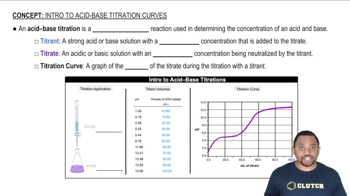
Acid-Base Titration

An acid-base titration is a quantitative analytical method used to determine the concentration of an acid or base in a solution. It involves the gradual addition of a titrant (a solution of known concentration) to a sample until the reaction reaches its equivalence point, where the amount of acid equals the amount of base. The choice of indicator is crucial, as it signals the endpoint of the titration through a color change.
추천 영상:
가이드 코스
03:04
Acid-Base Titration

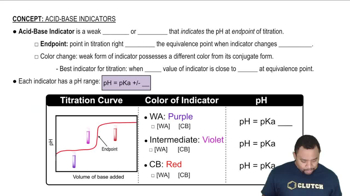
Indicators

Indicators are substances that change color at a specific pH range, making them useful for determining the endpoint of a titration. Different indicators are suitable for different types of titrations based on the pH at which the equivalence point occurs. For titrations involving strong acids and weak bases, such as CH3NH2 (methylamine), an indicator that changes color in the acidic pH range is typically selected.
추천 영상:
가이드 코스
04:30
Acid-Base Indicators

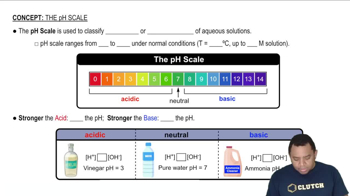
pH and pKa

pH is a measure of the acidity or basicity of a solution, while pKa is the negative logarithm of the acid dissociation constant (Ka) of a weak acid. The pKa value helps predict the pH at which an acid or base will be half dissociated. In the context of titration, knowing the pKa of the weak base (like CH3NH2) allows for the selection of an appropriate indicator that will change color at the pH corresponding to the equivalence point of the titration.
추천 영상: