Ch.18 - Aqueous Ionic Equilibrium
Tro - Chemistry: A Molecular Approach 5th Edition
Tro5th EditionChemistry: A Molecular ApproachISBN: 9780134874371당신이 사용하는 게 아니라요?교과서 변경
18장, 문제 135

What relative masses of dimethylamine and dimethylammonium chloride are needed to prepare a buffer solution with a pH of 10.43?

검증된 단계별 안내
1
Identify the components of the buffer solution: dimethylamine (a weak base) and dimethylammonium chloride (its conjugate acid).
Use the Henderson-Hasselbalch equation for a buffer solution: \( \text{pH} = \text{pK}_a + \log \left( \frac{[\text{Base}]}{[\text{Acid}]} \right) \).
Find the \( \text{pK}_a \) of dimethylammonium chloride. This can be done by using the relationship \( \text{pK}_a + \text{pK}_b = 14 \), where \( \text{pK}_b \) is for dimethylamine.
Rearrange the Henderson-Hasselbalch equation to solve for the ratio \( \frac{[\text{Base}]}{[\text{Acid}]} \): \( \frac{[\text{Base}]}{[\text{Acid}]} = 10^{(\text{pH} - \text{pK}_a)} \).
Calculate the relative masses of dimethylamine and dimethylammonium chloride needed using the molar masses and the ratio obtained from the Henderson-Hasselbalch equation.

주요 개념

질문에 올바르게 답하기 위해 반드시 이해해야 하는 핵심 개념들은 다음과 같습니다.

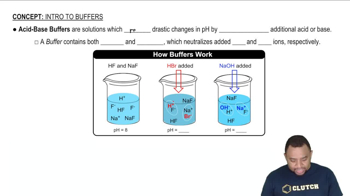
Buffer Solutions

Buffer solutions are mixtures that resist changes in pH when small amounts of acid or base are added. They typically consist of a weak acid and its conjugate base or a weak base and its conjugate acid. In this case, dimethylamine acts as the weak base, while dimethylammonium chloride serves as its conjugate acid, allowing the solution to maintain a stable pH.
추천 영상:
가이드 코스
03:02
Buffer Solutions

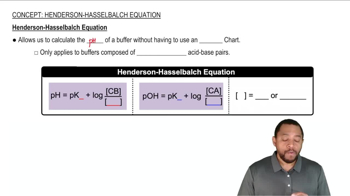
Henderson-Hasselbalch Equation

The Henderson-Hasselbalch equation is a mathematical formula used to calculate the pH of a buffer solution. It is expressed as pH = pKa + log([A-]/[HA]), where [A-] is the concentration of the base and [HA] is the concentration of the acid. This equation is essential for determining the relative amounts of dimethylamine and dimethylammonium chloride needed to achieve the desired pH of 10.43.
추천 영상:
가이드 코스
02:40
Henderson-Hasselbalch Equation

pKa and pH Relationship

The pKa is the negative logarithm of the acid dissociation constant (Ka) and indicates the strength of an acid in solution. The relationship between pKa and pH is crucial for buffer preparation, as it helps determine how much of the acid and base components are required to achieve a specific pH. For dimethylammonium chloride, knowing its pKa allows for the calculation of the necessary concentrations of both components to maintain the target pH.
추천 영상:
가이드 코스
02:09
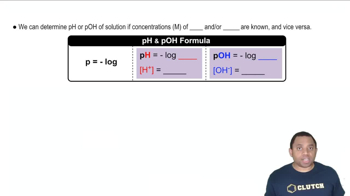
pH and pOH Calculations