Ch.2 - Atoms & Elements
Tro - Chemistry: A Molecular Approach 5th Edition
Tro5th EditionChemistry: A Molecular ApproachISBN: 9780134874371당신이 사용하는 게 아니라요?교과서 변경
2장, 문제 45b

On a dry day, your body can accumulate static charge from walking across a carpet or from brushing your hair. If your body develops a charge of -15 µC (microcoulombs), what is their collective mass?

검증된 단계별 안내
1
Identify the charge given in the problem, which is -15 mC (microcoulombs). Note that 1 microcoulomb (mC) equals \(1 imes 10^{-6}\) coulombs (C).
Recognize that the charge carriers in the human body are primarily electrons. The charge of one electron is approximately \(-1.602 imes 10^{-19}\) coulombs.
Calculate the number of electrons corresponding to a total charge of -15 mC. Use the formula: Number of electrons = Total charge / Charge of one electron.
Determine the mass of one electron, which is approximately \(9.109 imes 10^{-31}\) kilograms.
Calculate the total mass of the electrons by multiplying the number of electrons by the mass of one electron.

비슷한 문제에 대한 검증된 영상 답변:

이 영상 해법은 위 문제에 도움이 된다고 튜터들이 추천한 것입니다.
영상 길이:
3m
도움이 되었나요?

주요 개념

질문에 올바르게 답하기 위해 반드시 이해해야 하는 핵심 개념들은 다음과 같습니다.

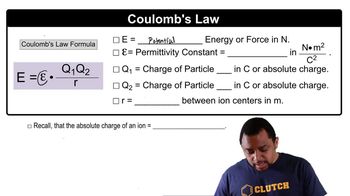
Coulomb's Law

Coulomb's Law describes the electrostatic force between charged objects. It states that the force is directly proportional to the product of the charges and inversely proportional to the square of the distance between them. This principle is fundamental in understanding how static charges interact, which is relevant when considering the accumulation of charge on the body.
추천 영상:
가이드 코스
01:15
Coulomb's Law Concept 2

Charge and Mass Relationship

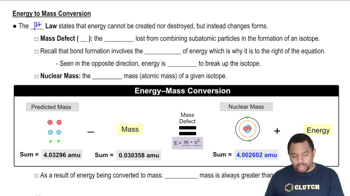
The relationship between charge and mass can be explored through the concept of charge-to-mass ratio. While charge itself does not have mass, the energy associated with a charge can be related to mass via Einstein's equation, E=mc². This concept is crucial for calculating the effective mass of a charged object based on its electric potential energy.
추천 영상:

Microcoulombs to Mass Conversion

To find the mass associated with a given charge, one can use the energy stored in the electric field created by the charge. The conversion involves calculating the energy using the charge and potential difference, then applying the mass-energy equivalence principle. This process allows for the determination of the mass equivalent of the static charge accumulated on the body.
추천 영상:
가이드 코스
04:12
Energy to Mass Conversion
관련 실천
교과서 질문

How many electrons are necessary to produce a charge of -1.0 C? What is the mass of this many electrons?

1766
views
2
rank
3
comments
교과서 질문

Which statements about subatomic particles are true? a. If an atom has an equal number of protons and electrons, it will be charge-neutral. b. Electrons are attracted to protons. c. Electrons are much lighter than neutrons. d. Protons have twice the mass of neutrons.

3004
views
1
rank
교과서 질문

Which statements about subatomic particles are false? a. Protons and electrons have charges of the same magnitude but opposite sign. b. Protons have about the same mass as neutrons. c. Some atoms don't have any protons. d. Protons and neutrons have charges of the same magnitude but opposite signs.

2256
views
1
rank
1
comments
교과서 질문

On a dry day, your body can accumulate static charge from walking across a carpet or from brushing your hair. If your body develops a charge of -15 µC (microcoulombs), how many excess electrons has it acquired?

749
views
교과서 질문

Imagine a unit of charge called the zorg. A chemist performs the oil drop experiment and measures the charge of each drop in zorgs. Based on the results shown here, what is the charge of the electron in zorgs (z)? How many electrons are in each drop?

Drop # Charge

A –4.8×10⁻⁹ z

B –9.6×10⁻⁹ z

C –6.4×10⁻⁹ z

D –12.8×10⁻⁹ z

3189
views
3
comments
교과서 질문

A chemist in an imaginary universe, where electrons have a different charge than they do in our universe, performs the Millikan oil drop experiment to measure the electron's charge. The charges of several drops are recorded here. What is the charge of the electron in this imaginary universe?

Drop # Charge

A –6.9×10⁻¹⁹ C

B –9.2×10⁻¹⁹ C

C –11.5×10⁻¹⁹ C

D –4.6×10⁻¹⁹ C

2325
views
3
comments