Upon decomposition, one sample of magnesium fluoride produces 1.65 kg of magnesium and 2.57 kg of fluorine. A second sample produces 1.32 kg of magnesium. How much fluorine (in grams) does the second sample produce?
Ch.2 - Atoms & Elements
2장, 문제 31
Two samples of carbon tetrachloride are decomposed into their constituent elements. One sample produces 38.9 g of carbon and 448 g of chlorine, and the other sample produces 14.8 g of carbon and 134 g of chlorine. Are these results consistent with the law of definite proportions? Explain your answer.
검증된 단계별 안내1
Identify the law of definite proportions, which states that a chemical compound always contains the same proportion of elements by mass.
Calculate the mass ratio of chlorine to carbon for the first sample: divide the mass of chlorine (448 g) by the mass of carbon (38.9 g).
Calculate the mass ratio of chlorine to carbon for the second sample: divide the mass of chlorine (134 g) by the mass of carbon (14.8 g).
Compare the two mass ratios obtained from the samples. If they are the same or very close, the results are consistent with the law of definite proportions.
Conclude whether the results are consistent with the law of definite proportions based on the comparison of the mass ratios.

비슷한 문제에 대한 검증된 영상 답변:
이 영상 해법은 위 문제에 도움이 된다고 튜터들이 추천한 것입니다.
영상 길이:
3m도움이 되었나요?
주요 개념
질문에 올바르게 답하기 위해 반드시 이해해야 하는 핵심 개념들은 다음과 같습니다.
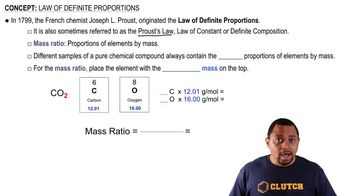
Law of Definite Proportions
The Law of Definite Proportions states that a chemical compound always contains its component elements in fixed ratio by mass, regardless of the amount of the compound or its source. For example, water (H2O) always consists of 2 hydrogen atoms and 1 oxygen atom, which translates to a specific mass ratio. This law is fundamental in determining whether the results of the decomposition of carbon tetrachloride are consistent across different samples.
추천 영상:
가이드 코스
Law of Definite Proportions
Mass Ratio Calculation
To assess consistency with the Law of Definite Proportions, one must calculate the mass ratios of the elements produced from each sample. This involves dividing the mass of carbon by the mass of chlorine for each sample. If the ratios are equivalent, it supports the idea that the samples are consistent with the law; if not, it suggests variability in composition.
추천 영상:
가이드 코스
Neutron-Proton Ratio
Stoichiometry
Stoichiometry is the branch of chemistry that deals with the quantitative relationships between the reactants and products in a chemical reaction. It allows chemists to predict the amounts of substances consumed and produced in a reaction. Understanding stoichiometry is essential for analyzing the results of the decomposition of carbon tetrachloride, as it helps in determining whether the observed mass ratios align with the expected ratios based on the compound's formula.
추천 영상:
가이드 코스
Stoichiometry Concept
관련 실천
교과서 질문
3159
views
1
rank
교과서 질문
The mass ratio of sodium to fluorine in sodium fluoride is 1.21:1. A sample of sodium fluoride produces 28.8 g of sodium upon decomposition. How much fluorine (in grams) forms?
2564
views
5
rank
교과서 질문
A hydrogen-filled balloon is ignited and 1.50 g of hydrogen is reacted with 12.0 g of oxygen. How many grams of water vapor form? (Assume that water vapor is the only product.)
2488
views
교과서 질문
An automobile gasoline tank holds 21 kg of gasoline. When the gasoline burns, 84 kg of oxygen is consumed, and carbon dioxide and water are produced. What is the total combined mass of carbon dioxide and water that is produced?
2737
views
교과서 질문
Identify the elements that have molecules as their basic units. a. hydrogen b. iodine c. lead d. oxygen
903
views