Ch.2 - Atoms & Elements
Tro - Chemistry: A Molecular Approach 5th Edition
Tro5th EditionChemistry: A Molecular ApproachISBN: 9780134874371당신이 사용하는 게 아니라요?교과서 변경
2장, 문제 83

What is the amount, in moles, of each elemental sample? a. 11.8 g Ar b. 3.55 g Zn c. 26.1 g Ta d. 0.211 g Li

검증된 단계별 안내
1
Identify the molar mass of argon (Ar) from the periodic table, which is approximately 39.95 g/mol.
Use the formula for moles: \( \text{moles} = \frac{\text{mass (g)}}{\text{molar mass (g/mol)}} \).
Substitute the given mass of argon (11.8 g) and its molar mass (39.95 g/mol) into the formula.
Calculate the division to find the number of moles of argon.
Express the result in moles, ensuring the units are correct.

비슷한 문제에 대한 검증된 영상 답변:

이 영상 해법은 위 문제에 도움이 된다고 튜터들이 추천한 것입니다.
영상 길이:
6m
도움이 되었나요?

주요 개념

질문에 올바르게 답하기 위해 반드시 이해해야 하는 핵심 개념들은 다음과 같습니다.

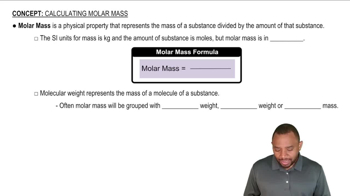
Molar Mass

Molar mass is the mass of one mole of a substance, typically expressed in grams per mole (g/mol). For elements, it corresponds to the atomic weight found on the periodic table. For example, the molar mass of argon (Ar) is approximately 39.95 g/mol, which is essential for converting grams of an element to moles.
추천 영상:
가이드 코스
02:11
Molar Mass Concept

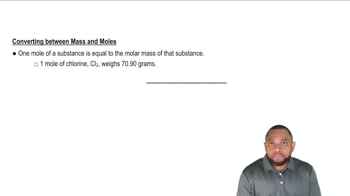
Conversion from Grams to Moles

To convert grams of a substance to moles, the formula used is: moles = mass (g) / molar mass (g/mol). This relationship allows chemists to quantify the amount of substance in a sample, facilitating calculations in stoichiometry and chemical reactions.
추천 영상:
가이드 코스
02:28
Mass and Moles Conversion

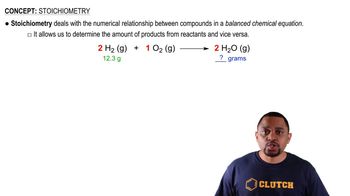
Stoichiometry

Stoichiometry is the branch of chemistry that deals with the quantitative relationships between the reactants and products in a chemical reaction. Understanding stoichiometry is crucial for determining how much of each substance is involved in a reaction, which is often based on the mole concept and molar mass calculations.
추천 영상:
가이드 코스
01:16
Stoichiometry Concept