
Ch.2 - Atoms & Elements
Tro - Chemistry: A Molecular Approach 5th Edition
Tro5th EditionChemistry: A Molecular ApproachISBN: 9780134874371당신이 사용하는 게 아니라요?교과서 변경
2장, 문제 42

Which statements are inconsistent with Rutherford's nuclear theory as it was originally stated? Why? a. Since electrons are smaller than protons, and since a hydrogen atom contains only one proton and one electron, it must follow that the volume of a hydrogen atom is mostly due to the proton. b. A nitrogen atom has 7 protons in its nucleus and 7 electrons outside of its nucleus. c. A phosphorus atom has 15 protons in its nucleus and 150 electrons outside of its nucleus. d. The majority of the mass of a fluorine atom is due to its 9 electrons.

검증된 단계별 안내
1
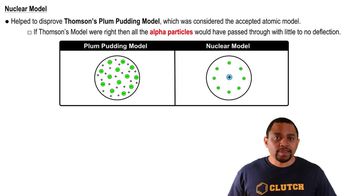
1. Rutherford's nuclear theory states that the atom is mostly empty space, with a tiny, dense, positively charged nucleus at the center and electrons moving around the nucleus. The volume of an atom is mostly due to the space that the electrons move in, not the nucleus.
2. Statement a is inconsistent with Rutherford's theory because it suggests that the volume of a hydrogen atom is mostly due to the proton, which contradicts Rutherford's idea that the atom's volume is mostly due to the space that the electrons move in.
3. Statement b is consistent with Rutherford's theory. It correctly states that a nitrogen atom has 7 protons in its nucleus and 7 electrons outside of its nucleus.
4. Statement c is inconsistent with Rutherford's theory because it suggests that a phosphorus atom has 150 electrons outside of its nucleus. In reality, a phosphorus atom has 15 electrons, equal to the number of protons in its nucleus, according to the atomic theory.
5. Statement d is inconsistent with Rutherford's theory because it suggests that the majority of the mass of a fluorine atom is due to its 9 electrons. In reality, the majority of an atom's mass is due to its protons and neutrons in the nucleus, not the electrons.

비슷한 문제에 대한 검증된 영상 답변:

이 영상 해법은 위 문제에 도움이 된다고 튜터들이 추천한 것입니다.
영상 길이:
2m
도움이 되었나요?

주요 개념

질문에 올바르게 답하기 위해 반드시 이해해야 하는 핵심 개념들은 다음과 같습니다.

Rutherford's Nuclear Theory

Rutherford's nuclear theory posits that an atom consists of a small, dense nucleus containing protons and neutrons, surrounded by electrons in a relatively large volume of empty space. This model was revolutionary as it shifted the understanding of atomic structure from the plum pudding model, emphasizing the nucleus's central role in mass and charge distribution within the atom.
추천 영상:

Atomic Structure and Mass Distribution

In atomic structure, the majority of an atom's mass is concentrated in the nucleus, which contains protons and neutrons, while electrons contribute negligibly to the overall mass. This understanding is crucial for evaluating statements about atomic volume and mass, as it clarifies that the size of an atom is largely due to the electron cloud rather than the nucleus.
추천 영상:

Electron Count and Charge Neutrality

Atoms are electrically neutral, meaning the number of protons (positively charged) equals the number of electrons (negatively charged). This principle is essential for understanding atomic composition, as any inconsistency in the number of electrons relative to protons indicates an ion rather than a neutral atom, which is critical for evaluating the statements in the question.
추천 영상:
관련 실천
교과서 질문

Which statements are consistent with Dalton's atomic theory as it was originally stated? Why? a. Sulfur and oxygen atoms have the same mass. b. All cobalt atoms are identical. c. Potassium and chlorine atoms combine in a 1:1 ratio to form potassium chloride. d. Lead atoms can be converted into gold.

1212
views
교과서 질문

Which statements are inconsistent with Dalton's atomic theory as it was originally stated? Why? a. All carbon atoms are identical. b. An oxygen atom combines with 1.5 hydrogen atoms to form a water molecule. c. Two oxygen atoms combine with a carbon atom to form a carbon dioxide molecule. d. The formation of a compound often involves the destruction of one or more atoms.

1720
views
교과서 질문

On a dry day, your body can accumulate static charge from walking across a carpet or from brushing your hair. If your body develops a charge of -15 µC (microcoulombs), how many excess electrons has it acquired?

749
views
교과서 질문

Imagine a unit of charge called the zorg. A chemist performs the oil drop experiment and measures the charge of each drop in zorgs. Based on the results shown here, what is the charge of the electron in zorgs (z)? How many electrons are in each drop?

Drop # Charge

A –4.8×10⁻⁹ z

B –9.6×10⁻⁹ z

C –6.4×10⁻⁹ z

D –12.8×10⁻⁹ z

3189
views
3
comments
교과서 질문

Which statements are consistent with Rutherford's nuclear theory as it was originally stated? Why? a. The volume of an atom is mostly empty space. b. The nucleus of an atom is small compared to the size of the atom. c. Neutral lithium atoms contain more neutrons than protons. d. Neutral lithium atoms contain more protons than electrons.

883
views
교과서 질문

A chemist in an imaginary universe, where electrons have a different charge than they do in our universe, performs the Millikan oil drop experiment to measure the electron's charge. The charges of several drops are recorded here. What is the charge of the electron in this imaginary universe?

Drop # Charge

A –6.9×10⁻¹⁹ C

B –9.2×10⁻¹⁹ C

C –11.5×10⁻¹⁹ C

D –4.6×10⁻¹⁹ C

2325
views
3
comments