Ch.20 - Electrochemistry
Tro - Chemistry: A Molecular Approach 5th Edition
Tro5th EditionChemistry: A Molecular ApproachISBN: 9780134874371당신이 사용하는 게 아니라요?교과서 변경
20장, 문제 117

If a water electrolysis cell operates at a current of 7.8 A, how long will it take to generate 25.0 L of hydrogen gas at a pressure of 25.0 atm and a temperature of 25 °C?

검증된 단계별 안내
1
Convert the volume of hydrogen gas from liters to moles using the ideal gas law: \( PV = nRT \), where \( P \) is pressure, \( V \) is volume, \( n \) is moles, \( R \) is the ideal gas constant, and \( T \) is temperature in Kelvin.
Calculate the moles of electrons required to produce the moles of hydrogen gas. Since the electrolysis of water produces hydrogen gas \( H_2 \), and each molecule of \( H_2 \) requires 2 electrons, multiply the moles of \( H_2 \) by 2.
Use Faraday's law of electrolysis to relate the charge to the moles of electrons: \( Q = nF \), where \( Q \) is the total charge in coulombs, \( n \) is the moles of electrons, and \( F \) is Faraday's constant (approximately 96485 C/mol).
Determine the time required to pass the calculated charge using the current: \( t = \frac{Q}{I} \), where \( t \) is time in seconds, \( Q \) is the charge in coulombs, and \( I \) is the current in amperes.
Convert the time from seconds to a more convenient unit if necessary, such as minutes or hours, for easier interpretation.

주요 개념

질문에 올바르게 답하기 위해 반드시 이해해야 하는 핵심 개념들은 다음과 같습니다.

Faraday's Laws of Electrolysis

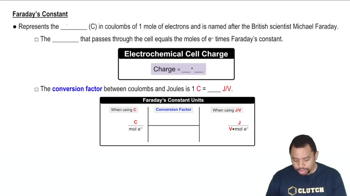
Faraday's Laws of Electrolysis state that the amount of substance produced at an electrode during electrolysis is directly proportional to the electric charge passed through the cell. This relationship allows us to calculate the moles of hydrogen gas generated based on the current and time, using the equation Q = I × t, where Q is the total charge, I is the current, and t is the time.
추천 영상:
가이드 코스
01:40
Faraday's Constant in Electrochemistry

Ideal Gas Law

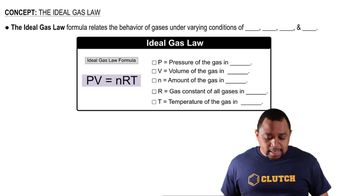
The Ideal Gas Law (PV = nRT) relates the pressure, volume, temperature, and number of moles of a gas. In this context, it can be used to determine the number of moles of hydrogen gas produced under specific conditions of pressure and temperature, which is essential for calculating how much charge is needed for electrolysis.
추천 영상:
가이드 코스
01:15
Ideal Gas Law Formula

Stoichiometry of Water Electrolysis

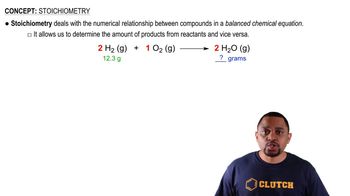
The stoichiometry of water electrolysis involves the balanced chemical reaction: 2H₂O(l) → 2H₂(g) + O₂(g). This indicates that for every 2 moles of water, 2 moles of hydrogen gas are produced. Understanding this ratio is crucial for converting the moles of hydrogen gas generated into the corresponding charge required for electrolysis.
추천 영상:
가이드 코스
01:16
Stoichiometry Concept