Ch.22 - Organic Chemistry
Tro - Chemistry: A Molecular Approach 5th Edition
Tro5th EditionChemistry: A Molecular ApproachISBN: 9780134874371당신이 사용하는 게 아니라요?교과서 변경
22장, 문제 75b

Name each aldehyde or ketone. b.

검증된 단계별 안내
1
Identify the functional group present in the compound. Aldehydes have the carbonyl group (C=O) at the end of the carbon chain, while ketones have it within the carbon chain.
Determine the longest carbon chain that contains the carbonyl group. This will help in identifying the base name of the compound.
For aldehydes, replace the '-e' ending of the corresponding alkane with '-al'. For ketones, replace the '-e' ending with '-one'.
Number the carbon chain starting from the end nearest to the carbonyl group. This helps in assigning the lowest possible number to the carbonyl carbon.
If there are substituents, name and number them according to their position on the carbon chain, and list them in alphabetical order before the base name.

비슷한 문제에 대한 검증된 영상 답변:

이 영상 해법은 위 문제에 도움이 된다고 튜터들이 추천한 것입니다.
영상 길이:
2m
도움이 되었나요?

주요 개념

질문에 올바르게 답하기 위해 반드시 이해해야 하는 핵심 개념들은 다음과 같습니다.

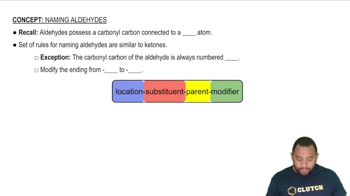
Aldehydes

Aldehydes are organic compounds characterized by the presence of a carbonyl group (C=O) at the end of a carbon chain. The general formula for aldehydes is RCHO, where R represents a hydrocarbon group. Common examples include formaldehyde and acetaldehyde. Aldehydes are known for their distinctive odors and are often used in the production of various chemicals and as preservatives.
추천 영상:
가이드 코스
00:54
Rules for Naming Aldehydes

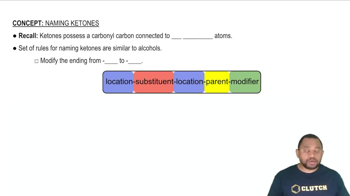
Ketones

Ketones are organic compounds that contain a carbonyl group (C=O) located within a carbon chain, specifically between two carbon atoms. The general formula for ketones is RC(=O)R', where R and R' can be the same or different hydrocarbon groups. Acetone is a well-known example of a ketone, commonly used as a solvent. Ketones are important in various chemical reactions and industrial applications.
추천 영상:
가이드 코스
00:39
Rules for Naming Ketones

Nomenclature of Organic Compounds

The nomenclature of organic compounds follows specific rules set by the International Union of Pure and Applied Chemistry (IUPAC). For aldehydes, the suffix '-al' is used, while for ketones, the suffix '-one' is applied. The naming process involves identifying the longest carbon chain containing the functional group, numbering the chain to give the functional group the lowest possible number, and then applying the appropriate suffix based on the compound type.
추천 영상:
가이드 코스
02:26
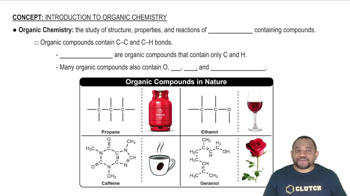
Introduction to Organic Chemistry