Ch.3 - Molecules and Compounds
Tro - Chemistry: A Molecular Approach 5th Edition
Tro5th EditionChemistry: A Molecular ApproachISBN: 9780134874371당신이 사용하는 게 아니라요?교과서 변경
3장, 문제 124

Researchers obtained the following data from experiments to find the molecular formula of benzocaine, a local anesthetic, which contains only carbon, hydrogen, nitrogen, and oxygen. Complete combustion of a 3.54-g sample of benzocaine with excess O2 forms 8.49 g of CO2 and 2.14 g H2O. Another 2.35-g sample contains 0.199 g of N. The molar mass of benzocaine is 165 g/mol. Find the molar formula of benzocaine.

검증된 단계별 안내
1
Calculate the moles of carbon in the CO2 produced: Use the mass of CO2 (8.49 g) and the molar mass of CO2 (44.01 g/mol) to find the moles of CO2, then use the stoichiometry of CO2 to find the moles of carbon.
Calculate the moles of hydrogen in the H2O produced: Use the mass of H2O (2.14 g) and the molar mass of H2O (18.02 g/mol) to find the moles of H2O, then use the stoichiometry of H2O to find the moles of hydrogen.
Calculate the moles of nitrogen in the sample: Use the mass of nitrogen (0.199 g) and the molar mass of nitrogen (14.01 g/mol) to find the moles of nitrogen.
Determine the mass of oxygen in benzocaine: Subtract the mass of carbon, hydrogen, and nitrogen from the total mass of the benzocaine sample (3.54 g) to find the mass of oxygen, then convert this mass to moles using the molar mass of oxygen (16.00 g/mol).
Determine the empirical formula: Use the moles of each element to find the simplest whole number ratio, then use the molar mass of benzocaine (165 g/mol) to convert the empirical formula to the molecular formula.

비슷한 문제에 대한 검증된 영상 답변:

이 영상 해법은 위 문제에 도움이 된다고 튜터들이 추천한 것입니다.
영상 길이:
6m
도움이 되었나요?

주요 개념

질문에 올바르게 답하기 위해 반드시 이해해야 하는 핵심 개념들은 다음과 같습니다.

Combustion Analysis

Combustion analysis is a technique used to determine the elemental composition of organic compounds. In this method, a sample is burned in excess oxygen, producing carbon dioxide and water. The masses of these products are measured, allowing for the calculation of the amounts of carbon and hydrogen in the original sample. This data is crucial for deriving the empirical formula of the compound.
추천 영상:
가이드 코스
01:29
Combustion of Non-Hydrocarbons

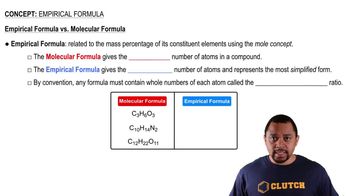
Empirical Formula

The empirical formula represents the simplest whole-number ratio of the elements in a compound. It is derived from the mass percentages of each element obtained from combustion analysis. For benzocaine, after determining the moles of carbon, hydrogen, nitrogen, and oxygen, the empirical formula can be calculated, which serves as a stepping stone to finding the molecular formula.
추천 영상:
가이드 코스
02:26
Empirical vs Molecular Formula

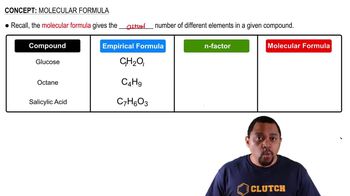
Molecular Formula

The molecular formula indicates the actual number of atoms of each element in a molecule of a compound. It can be derived from the empirical formula by using the compound's molar mass. In the case of benzocaine, knowing the empirical formula and the molar mass (165 g/mol) allows for the calculation of the molecular formula, which reveals the true composition of the compound.
추천 영상:
가이드 코스
02:08
Determining Molecular Formulas