Ch.3 - Molecules and Compounds
Tro - Chemistry: A Molecular Approach 5th Edition
Tro5th EditionChemistry: A Molecular ApproachISBN: 9780134874371당신이 사용하는 게 아니라요?교과서 변경
3장, 문제 79a

Write a ratio showing the relationship between the molar amounts of each element for each compound. (See Appendix IIA for color codes.) (a)
Illustration of molecular structures showing the Law of Definite Proportions in compounds.

검증된 단계별 안내
1
Identify the elements present in the molecular structures shown in the image. The blue spheres represent one element, and the red spheres represent another element.
Count the number of blue spheres and red spheres in one molecule to determine the ratio of the elements in a single molecule.
Observe that each molecule consists of one blue sphere and three red spheres.
Write the ratio of the molar amounts of the elements in the compound. Since there is one blue sphere for every three red spheres, the ratio is 1:3.
Express the ratio in terms of the elements, for example, if the blue sphere represents element A and the red sphere represents element B, the ratio of A to B in the compound is 1:3.

비슷한 문제에 대한 검증된 영상 답변:

이 영상 해법은 위 문제에 도움이 된다고 튜터들이 추천한 것입니다.
영상 길이:
52s
도움이 되었나요?

주요 개념

질문에 올바르게 답하기 위해 반드시 이해해야 하는 핵심 개념들은 다음과 같습니다.

Molar Ratio

A molar ratio is a relationship between the amounts of different substances in a chemical reaction, expressed in moles. It is derived from the coefficients of a balanced chemical equation and indicates how many moles of one substance react with or produce moles of another. Understanding molar ratios is essential for stoichiometric calculations, allowing chemists to predict the quantities of reactants and products involved in a reaction.
추천 영상:
가이드 코스
02:14
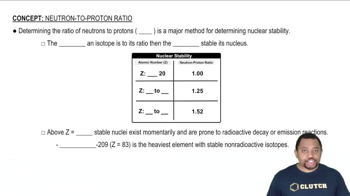
Neutron-Proton Ratio

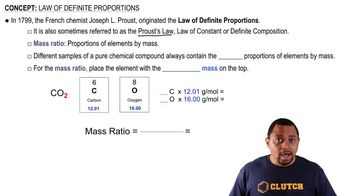
Law of Definite Proportions

The Law of Definite Proportions states that a chemical compound always contains its component elements in fixed ratio by mass, regardless of the sample size or source. This principle is fundamental in chemistry as it ensures that compounds have consistent compositions, which is crucial for understanding chemical formulas and reactions. For example, water (H2O) always consists of two hydrogen atoms and one oxygen atom.
추천 영상:
가이드 코스
02:48
Law of Definite Proportions

Chemical Formula

A chemical formula is a symbolic representation of a compound that indicates the types and numbers of atoms present. It provides essential information about the composition of a substance, such as the ratio of elements in a compound. For instance, the formula C6H12O6 for glucose shows that it contains six carbon atoms, twelve hydrogen atoms, and six oxygen atoms, reflecting the specific molar ratios of these elements.
추천 영상:
가이드 코스
02:26
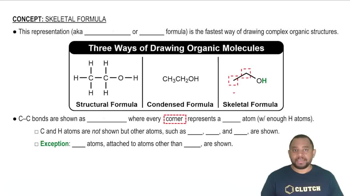
Skeletal Formula