Ch.5 - Introduction to Solutions and Aqueous Solutions
Tro - Chemistry: A Molecular Approach 5th Edition
Tro5th EditionChemistry: A Molecular ApproachISBN: 9780134874371당신이 사용하는 게 아니라요?교과서 변경
5장, 문제 58

A 30.00-mL sample of an unknown H3PO4 solution is titrated with a 0.100 M NaOH solution. The equivalence point is reached when 26.38 mL of NaOH solution is added. What is the concentration of the unknown H3PO4 solution? The neutralization reaction is H3PO4(aq) + 3 NaOH(aq) → 3 H2O(l) + Na3PO4(aq)

검증된 단계별 안내
1
Determine the total moles of NaOH used in the titration. Use the formula: moles = concentration (M) imes volume (L). Convert the volume of NaOH from mL to L by dividing by 1000.
From the balanced chemical equation, H3PO4(aq) + 3 NaOH(aq) → 3 H2O(l) + Na3PO4(aq), note that 1 mole of H3PO4 reacts with 3 moles of NaOH. Calculate the moles of H3PO4 by dividing the moles of NaOH by 3.
Calculate the concentration of the H3PO4 solution. Use the formula: concentration (M) = moles of solute / volume of solution (L). Convert the volume of the H3PO4 solution from mL to L by dividing by 1000.
Ensure the units are consistent when performing the calculations to avoid any errors in the final concentration.
Check your calculations for any possible arithmetic errors to ensure the accuracy of the concentration of the H3PO4 solution.

비슷한 문제에 대한 검증된 영상 답변:

이 영상 해법은 위 문제에 도움이 된다고 튜터들이 추천한 것입니다.
영상 길이:
4m
도움이 되었나요?

주요 개념

질문에 올바르게 답하기 위해 반드시 이해해야 하는 핵심 개념들은 다음과 같습니다.

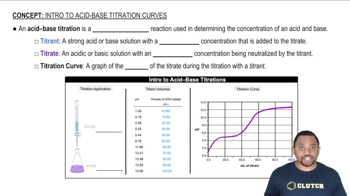
Titration

Titration is a quantitative analytical technique used to determine the concentration of a solute in a solution. It involves the gradual addition of a titrant, a solution of known concentration, to a sample until the reaction reaches its equivalence point, where the amount of titrant equals the amount of substance in the sample. This method is commonly used in acid-base reactions to find the concentration of an unknown acid or base.
추천 영상:
가이드 코스
03:04
Acid-Base Titration

Stoichiometry

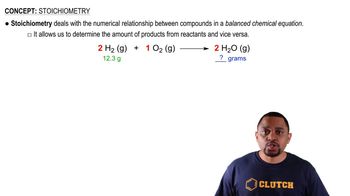
Stoichiometry is the calculation of reactants and products in chemical reactions based on the balanced chemical equation. It allows chemists to determine the relationships between the quantities of substances involved in a reaction. In this case, the stoichiometry of the reaction between phosphoric acid (H3PO4) and sodium hydroxide (NaOH) indicates that one mole of H3PO4 reacts with three moles of NaOH, which is crucial for calculating the concentration of the unknown solution.
추천 영상:
가이드 코스
01:16
Stoichiometry Concept

Molarity

Molarity is a measure of concentration defined as the number of moles of solute per liter of solution. It is expressed in moles per liter (M). In this titration problem, the molarity of the NaOH solution is given, and by using the volume of NaOH added at the equivalence point, one can calculate the moles of NaOH used, which can then be related back to the moles of H3PO4 to find its concentration.
추천 영상: