Write balanced complete ionic and net ionic equations for each acid–base reaction. a. HI(aq) + RbOH(aq) →
Ch.5 - Introduction to Solutions and Aqueous Solutions
5장, 문제 53
Complete and balance each acid–base equation.
a. H2SO4(aq) + Ca(OH)2(aq) →
b. HClO4(aq) + KOH(aq) →
c. H2SO4(aq) + NaOH(aq) →
검증된 단계별 안내1
Identify the type of reaction: This is an acid-base neutralization reaction where sulfuric acid (H2SO4) reacts with sodium hydroxide (NaOH).
Write the unbalanced chemical equation: H2SO4(aq) + NaOH(aq) → Na2SO4(aq) + H2O(l).
Balance the equation by ensuring the number of atoms of each element is the same on both sides. Start by balancing the sodium (Na) atoms.
Since H2SO4 has two acidic hydrogens, it will react with two NaOH molecules. Adjust the coefficients: H2SO4(aq) + 2 NaOH(aq) → Na2SO4(aq) + 2 H2O(l).
Verify the balance: Check that the number of each type of atom (H, S, O, Na) is equal on both sides of the equation.

비슷한 문제에 대한 검증된 영상 답변:
이 영상 해법은 위 문제에 도움이 된다고 튜터들이 추천한 것입니다.
영상 길이:
3m도움이 되었나요?
주요 개념
질문에 올바르게 답하기 위해 반드시 이해해야 하는 핵심 개념들은 다음과 같습니다.
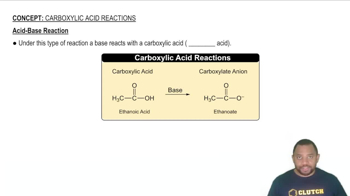
Acid-Base Reactions
Acid-base reactions involve the transfer of protons (H+) between reactants. In this context, sulfuric acid (H2SO4) acts as an acid, donating protons, while sodium hydroxide (NaOH) serves as a base, accepting protons. The result is the formation of water and a salt, showcasing the neutralization process typical of acid-base reactions.
추천 영상:
가이드 코스
Acid-Base Reaction
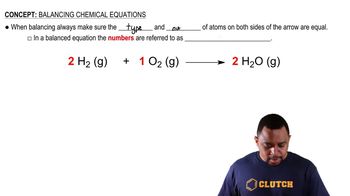
Balancing Chemical Equations
Balancing chemical equations is essential to ensure that the number of atoms for each element is the same on both sides of the equation. This reflects the law of conservation of mass, which states that matter cannot be created or destroyed in a chemical reaction. In the given equation, coefficients are adjusted to achieve balance, particularly for the products formed.
추천 영상:
가이드 코스
Balancing Chemical Equations
Strong Acids and Bases
Strong acids and bases completely dissociate in aqueous solutions. H2SO4 is a strong acid that dissociates into H+ and HSO4- ions, while NaOH is a strong base that dissociates into Na+ and OH- ions. Understanding their complete dissociation is crucial for predicting the products of the reaction and for balancing the equation accurately.
추천 영상:
가이드 코스
Strong Acid-Strong Base Titration
관련 실천
교과서 질문
1345
views
교과서 질문
Lead(II) ions can be removed from solution by precipitation with sulfate ions. Suppose that a solution contains lead(II) nitrate. Write complete ionic and net ionic equations for the reaction of aqueous lead(II) nitrate with aqueous potassium sulfate to form solid lead(II) sulfate and aqueous potassium nitrate.
1328
views
교과서 질문
Write balanced molecular and net ionic equations for the reaction between nitric acid and calcium hydroxide.
711
views
교과서 질문
Write balanced complete ionic and net ionic equations for each acid–base reaction.
b. HCHO2(aq) + NaOH(aq) →
c. HC2H3O2(aq) + LiOH(aq) →
991
views
교과서 질문
Complete and balance each acid–base equation. b. HC2H3O2(aq) + Ca(OH)2(aq) →
1140
views
교과서 질문
Write balanced molecular and net ionic equations for the reaction between hydrobromic acid and potassium hydroxide.
651
views