
교과서 질문
Write a molecular equation for the precipitation reaction that occurs (if any) when each pair of aqueous solutions is mixed. If no reaction occurs, write 'NO REACTION.' c. copper(II) nitrate and magnesium sulfide
1654
views
 검증된 단계별 안내
 00:47
00:47
 00:51
00:51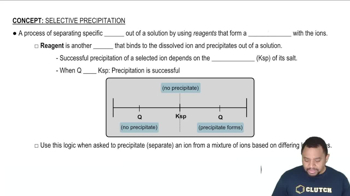 01:53
01:53Write a molecular equation for the precipitation reaction that occurs (if any) when each pair of aqueous solutions is mixed. If no reaction occurs, write 'NO REACTION.' c. copper(II) nitrate and magnesium sulfide
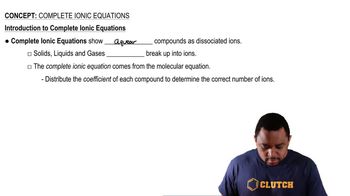
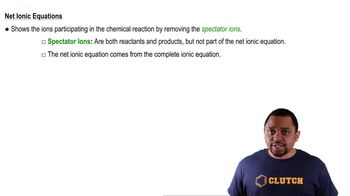
Write balanced complete ionic and net ionic equations for each reaction.
c. NaOH(aq) + HC2H3O2(aq) → H2O(l ) + NaC2H3O2(aq)
d. Na3PO4(aq) + NiCl2(aq) → Ni3(PO4)2(s) + NaCl(aq)
Write balanced complete ionic and net ionic equations for each reaction. d. Na3PO4(aq) + NiCl2(aq) → Ni3(PO4)2(s) + NaCl(aq)
Write balanced complete ionic and net ionic equations for each reaction. a. K2SO4(aq) + CaI2(aq) → CaSO4(s) + KI(aq)
Write a molecular equation for the precipitation reaction that occurs (if any) when each pair of aqueous solutions is mixed. If no reaction occurs, write 'NO REACTION.' a. sodium chloride and lead(II) acetate b. potassium sulfate and strontium iodide c. cesium chloride and calcium sulfide d. chromium(III) nitrate and sodium phosphate
Write balanced complete ionic and net ionic equations for each reaction. a. HCl(aq) + LiOH(aq) → H2O(l) + LiCl(aq)