Ch.7 - Thermochemistry
Tro - Chemistry: A Molecular Approach 5th Edition
Tro5th EditionChemistry: A Molecular ApproachISBN: 9780134874371당신이 사용하는 게 아니라요?교과서 변경
7장, 문제 34c

Convert between energy units. c. 4.99 × 10³ kJ to kWh

검증된 단계별 안내
1
Identify the conversion factor between kilojoules (kJ) and kilowatt-hours (kWh). The conversion factor is 1 kWh = 3600 kJ.
Write down the given energy in kilojoules, which is 4.99 \(\times\) 10^3 kJ.
Set up the conversion equation using the conversion factor. You want to convert kJ to kWh, so divide the energy in kJ by the conversion factor (3600 kJ/kWh).
Perform the division to convert the energy from kJ to kWh. This involves dividing 4.99 \(\times\) 10^3 kJ by 3600 kJ/kWh.
The result from the division will give you the energy in kilowatt-hours (kWh).

비슷한 문제에 대한 검증된 영상 답변:

이 영상 해법은 위 문제에 도움이 된다고 튜터들이 추천한 것입니다.
영상 길이:
57s
도움이 되었나요?

주요 개념

질문에 올바르게 답하기 위해 반드시 이해해야 하는 핵심 개념들은 다음과 같습니다.

Energy Units

Energy can be measured in various units, with kilojoules (kJ) and kilowatt-hours (kWh) being common in chemistry and electrical contexts. A kilojoule is a unit of energy equal to 1,000 joules, while a kilowatt-hour is the energy consumed by a power of one kilowatt running for one hour, equivalent to 3.6 million joules.
추천 영상:

Conversion Factors

To convert between different energy units, specific conversion factors are used. For instance, to convert kJ to kWh, one must know that 1 kWh equals 3.6 million joules. Therefore, the conversion involves dividing the energy in kJ by 3,600 to obtain the equivalent in kWh.
추천 영상:
가이드 코스
01:56
Conversion Factors

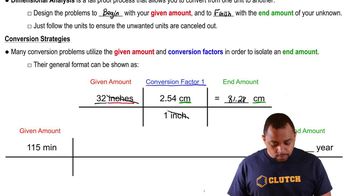
Dimensional Analysis

Dimensional analysis is a mathematical technique used to convert units by multiplying by conversion factors that cancel out unwanted units. This method ensures that the final answer is in the desired unit, making it a crucial tool for solving problems involving unit conversions in chemistry.
추천 영상:
가이드 코스
06:11
Dimensional Analysis