Ch.7 - Thermochemistry
Tro - Chemistry: A Molecular Approach 5th Edition
Tro5th EditionChemistry: A Molecular ApproachISBN: 9780134874371당신이 사용하는 게 아니라요?교과서 변경
7장, 문제 69

Two substances, A and B, initially at different temperatures, come into contact and reach thermal equilibrium. The mass of substance A is 6.15 g and its initial temperature is 20.5 °C. The mass of substance B is 25.2 g and its initial temperature is 52.7 °C. The final temperature of both substances at thermal equilibrium is 46.7 °C. If the specific heat capacity of substance B is 1.17 J/g•°C, what is the specific heat capacity of substance A?

검증된 단계별 안내
1
Identify the principle of conservation of energy, which states that the heat lost by substance B will be equal to the heat gained by substance A.
Write the formula for heat transfer: \( q = m \cdot c \cdot \Delta T \), where \( q \) is the heat transferred, \( m \) is the mass, \( c \) is the specific heat capacity, and \( \Delta T \) is the change in temperature.
Calculate the change in temperature for each substance: \( \Delta T_A = T_{\text{final}} - T_{\text{initial, A}} \) and \( \Delta T_B = T_{\text{final}} - T_{\text{initial, B}} \).
Set up the equation for heat transfer: \( m_A \cdot c_A \cdot \Delta T_A = - (m_B \cdot c_B \cdot \Delta T_B) \). Note that the heat gained by A is equal to the negative of the heat lost by B.
Rearrange the equation to solve for the specific heat capacity of substance A: \( c_A = - \frac{m_B \cdot c_B \cdot \Delta T_B}{m_A \cdot \Delta T_A} \).

비슷한 문제에 대한 검증된 영상 답변:

이 영상 해법은 위 문제에 도움이 된다고 튜터들이 추천한 것입니다.
도움이 되었나요?

주요 개념

질문에 올바르게 답하기 위해 반드시 이해해야 하는 핵심 개념들은 다음과 같습니다.

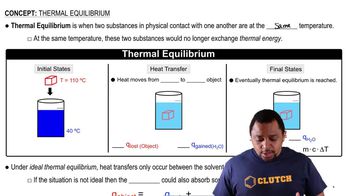
Thermal Equilibrium

Thermal equilibrium occurs when two substances at different temperatures come into contact and exchange heat until they reach the same temperature. At this point, the heat lost by the hotter substance equals the heat gained by the cooler substance, resulting in no net heat flow between them. This principle is fundamental in calorimetry and helps in understanding heat transfer in physical systems.
추천 영상:
가이드 코스
02:35
Thermal Equilibrium

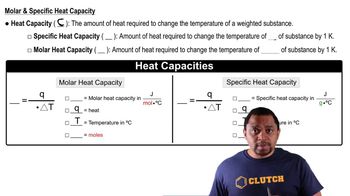
Specific Heat Capacity

Specific heat capacity is the amount of heat required to raise the temperature of one gram of a substance by one degree Celsius. It is a material-specific property that indicates how much energy a substance can store or release as its temperature changes. Knowing the specific heat capacities of substances allows for calculations involving heat transfer and temperature changes in thermal processes.
추천 영상:

Heat Transfer Equation

The heat transfer equation, often expressed as Q = mcΔT, relates the heat (Q) absorbed or released by a substance to its mass (m), specific heat capacity (c), and the change in temperature (ΔT). This equation is crucial for solving problems involving thermal equilibrium, as it allows for the calculation of unknown variables, such as specific heat capacity, when the other parameters are known.
추천 영상: