Ch.8 - The Quantum-Mechanical Model of the Atom
Tro - Chemistry: A Molecular Approach 5th Edition
Tro5th EditionChemistry: A Molecular ApproachISBN: 9780134874371당신이 사용하는 게 아니라요?교과서 변경
8장, 문제 77

In a technique used for surface analysis called Auger electron spectroscopy (AES), electrons are accelerated toward a metal surface. These electrons cause the emissions of secondary electrons—called Auger electrons—from the metal surface. The kinetic energy of the Auger electrons depends on the composition of the surface. The presence of oxygen atoms on the surface results in Auger electrons with a kinetic energy of approximately 506 eV. What is the de Broglie wavelength of one of these electrons? [KE = 1/2mv^2; 1 electron volt (eV) = 1.602 * 10^(-19) J]

검증된 단계별 안내
1
Convert the kinetic energy from electron volts (eV) to joules (J) using the conversion factor: 1 eV = 1.602 \(\times\) 10^{-19} J.
Use the kinetic energy formula KE = \(\frac{1}{2}\)mv^2 to solve for the velocity (v) of the electron. Rearrange the formula to v = \(\sqrt{\frac{2 \times KE}{m}\)}, where m is the mass of an electron (9.109 \(\times\) 10^{-31} kg).
Substitute the kinetic energy in joules and the mass of the electron into the velocity equation to find the velocity.
Use the de Broglie wavelength formula \(\lambda\) = \(\frac{h}{mv}\), where h is Planck's constant (6.626 \(\times\) 10^{-34} m^2 kg/s).
Substitute the values for Planck's constant, the mass of the electron, and the velocity into the de Broglie wavelength formula to find the wavelength.

주요 개념

질문에 올바르게 답하기 위해 반드시 이해해야 하는 핵심 개념들은 다음과 같습니다.

Kinetic Energy and Electron Mass

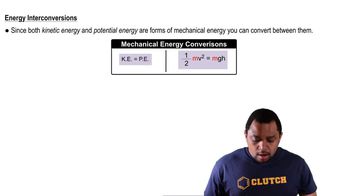
Kinetic energy (KE) is the energy an object possesses due to its motion, calculated using the formula KE = 1/2 mv^2, where m is mass and v is velocity. For electrons, which have a very small mass (approximately 9.11 x 10^-31 kg), their kinetic energy can be converted from electron volts (eV) to joules (J) for calculations. Understanding this relationship is crucial for determining the velocity of the electrons based on their kinetic energy.
추천 영상:
가이드 코스
00:34
Kinetic & Potential Energy

de Broglie Wavelength

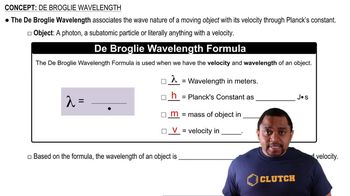
The de Broglie wavelength is a concept that describes the wave-like behavior of particles, including electrons. It is given by the formula λ = h/p, where λ is the wavelength, h is Planck's constant (6.626 x 10^-34 Js), and p is the momentum of the particle. For electrons, momentum can be expressed as p = mv, linking their mass and velocity to their wave properties, which is essential for understanding their behavior in quantum mechanics.
추천 영상:
가이드 코스
00:58
De Broglie Wavelength Formula

Conversion of Energy Units

In the context of this problem, converting energy from electron volts (eV) to joules (J) is necessary for calculations involving kinetic energy and de Broglie wavelength. The conversion factor is 1 eV = 1.602 x 10^-19 J. This understanding is vital for accurately applying the kinetic energy in the de Broglie wavelength formula, ensuring that all units are consistent and calculations yield correct results.
추천 영상:
가이드 코스
01:56
Conversion Factors
관련 실천
교과서 질문

An X-ray photon of wavelength 0.989 nm strikes a surface. The emitted electron has a kinetic energy of 969 eV. What is the binding energy of the electron in kJ/mol? [KE = 1/2 mv2; 1 electron volt (eV) = 1.602×10⁻¹⁹ J]

3704
views
1
comments
교과서 질문

Ionization involves completely removing an electron from an atom. How much energy is required to ionize a hydrogen atom in its ground (or lowest energy) state? What wavelength of light contains enough energy in a single photon to ionize a hydrogen atom?

1801
views
1
comments
교과서 질문

The energy required to ionize sodium is 496 kJ/mol. What minimum frequency of light is required to ionize sodium?

1739
views
1
rank
교과서 질문

The human eye contains a molecule called 11-cis-retinal that changes shape when struck with light of sufficient energy. The change in shape triggers a series of events that results in an electrical signal being sent to the brain that results in vision. The minimum energy required to change the conformation of 11-cis-retinal within the eye is about 164 kJ/mol. Calculate the longest wavelength visible to the human eye.

5687
views
2
comments
교과서 질문

An argon ion laser puts out 5.0 W of continuous power at a wavelength of 532 nm. The diameter of the laser beam is 5.5 mm. If the laser is pointed toward a pinhole with a diameter of 1.2 mm, how many photons travel through the pinhole per second? Assume that the light intensity is equally distributed throughout the entire cross-sectional area of the beam. (1 W = 1 J/s)

1009
views