Ch.8 - The Quantum-Mechanical Model of the Atom
Tro - Chemistry: A Molecular Approach 5th Edition
Tro5th EditionChemistry: A Molecular ApproachISBN: 9780134874371당신이 사용하는 게 아니라요?교과서 변경
8장, 문제 57

Which electron is, on average, closer to the nucleus: an electron in a 2s orbital or an electron in a 3s orbital?

검증된 단계별 안내
1
Understand the concept of atomic orbitals and their energy levels. The principal quantum number, n, indicates the energy level and size of the orbital.
Recognize that the 2s orbital has a principal quantum number of n=2, while the 3s orbital has n=3.
Recall that orbitals with lower principal quantum numbers are generally closer to the nucleus.
Consider the radial distribution of s orbitals, which shows that electrons in lower energy levels (like 2s) are more likely to be found closer to the nucleus than those in higher energy levels (like 3s).
Conclude that, on average, an electron in a 2s orbital is closer to the nucleus than an electron in a 3s orbital due to the lower principal quantum number.

주요 개념

질문에 올바르게 답하기 위해 반드시 이해해야 하는 핵심 개념들은 다음과 같습니다.

Atomic Orbitals

Atomic orbitals are regions around the nucleus where electrons are likely to be found. They are defined by quantum numbers, which describe the energy level, shape, and orientation of the orbital. The 's' orbitals are spherical, and their size increases with the principal quantum number, meaning that a 3s orbital is larger than a 2s orbital.
추천 영상:
가이드 코스
01:51
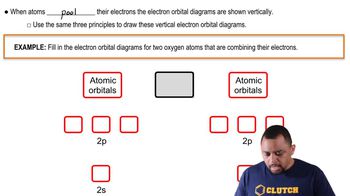
Atomic Orbitals Example

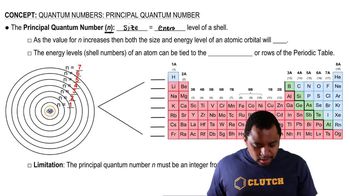
Principal Quantum Number

The principal quantum number (n) indicates the main energy level of an electron in an atom. It can take positive integer values (1, 2, 3, etc.), with higher numbers corresponding to higher energy levels and greater average distances from the nucleus. Therefore, electrons in a 2s orbital (n=2) are generally closer to the nucleus than those in a 3s orbital (n=3).
추천 영상:
가이드 코스
02:55
Principal Quantum Number

Electron Shielding

Electron shielding refers to the phenomenon where inner electrons repel outer electrons, reducing the effective nuclear charge felt by the outer electrons. In multi-electron atoms, this effect means that electrons in higher energy levels (like 3s) experience a weaker attraction to the nucleus compared to those in lower energy levels (like 2s), further supporting that 2s electrons are, on average, closer to the nucleus.
추천 영상:
가이드 코스
04:44
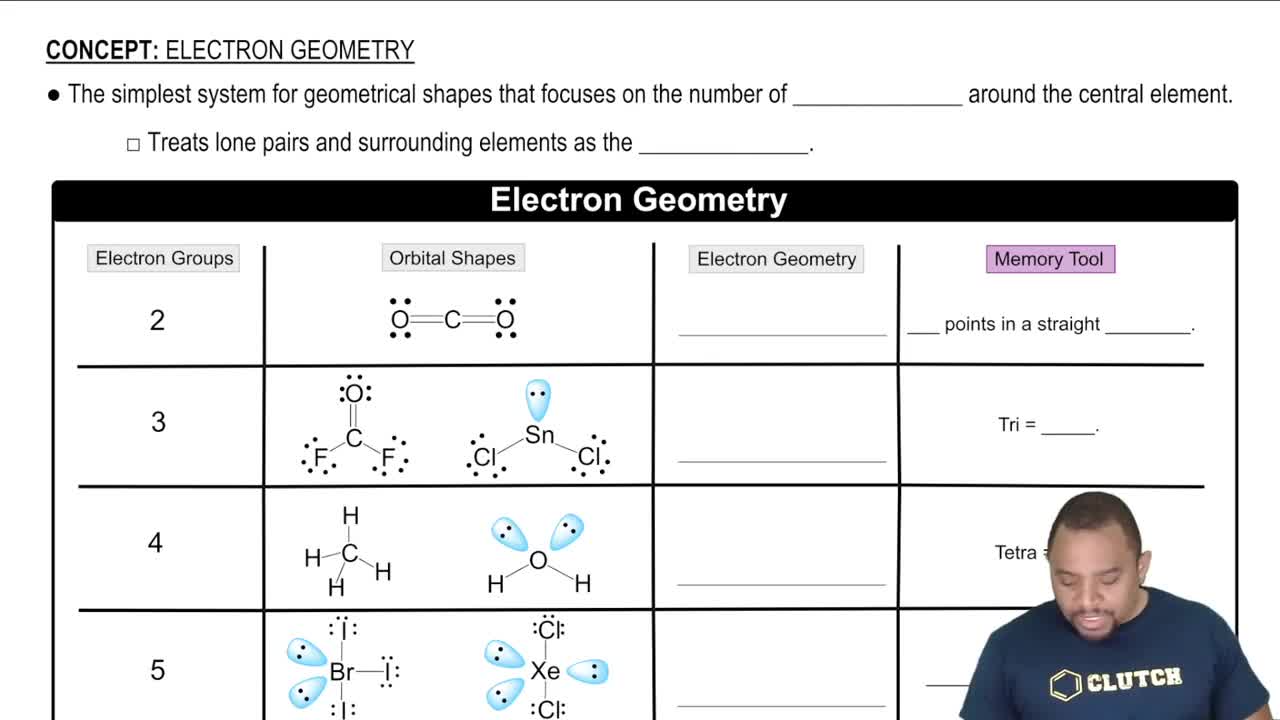
Electron Geometry