Choose the element with the higher first ionization energy from each pair. d. P or Sn
Ch.9 - Periodic Properties of the Elements
9장, 문제 73
Arrange these elements in order of increasing first ionization energy: Si, F, In, N.
검증된 단계별 안내1
Step 1: Understand that ionization energy is the energy required to remove an electron from an atom. The greater the ionization energy, the harder it is to remove an electron.
Step 2: Recall that ionization energy generally increases from left to right across a period (row) on the periodic table. This is because as you move across a period, the number of protons in the nucleus increases, which increases the positive charge and pulls the electrons closer to the nucleus, making them harder to remove.
Step 3: Also remember that ionization energy generally decreases from top to bottom down a group (column) on the periodic table. This is because as you move down a group, the electrons are further from the nucleus and are therefore easier to remove.
Step 4: Locate the elements Si, F, In, and N on the periodic table. Si and N are in the same period, with N to the right of Si, so N has a higher ionization energy than Si. F is in the same period as N but is to the right, so it has an even higher ionization energy. In is below Si in the same group, so it has a lower ionization energy.
Step 5: Therefore, the order of increasing first ionization energy is In, Si, N, F.

비슷한 문제에 대한 검증된 영상 답변:
이 영상 해법은 위 문제에 도움이 된다고 튜터들이 추천한 것입니다.
영상 길이:
4m주요 개념
질문에 올바르게 답하기 위해 반드시 이해해야 하는 핵심 개념들은 다음과 같습니다.
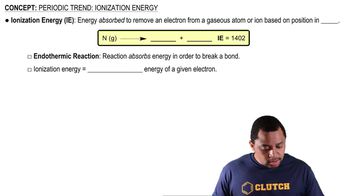
Ionization Energy
Ionization energy is the energy required to remove an electron from a gaseous atom or ion. It is a key factor in determining an element's reactivity and is influenced by the atomic size and the effective nuclear charge. Generally, ionization energy increases across a period due to increasing nuclear charge and decreases down a group due to increased distance from the nucleus.
추천 영상:
가이드 코스
Ionization Energy
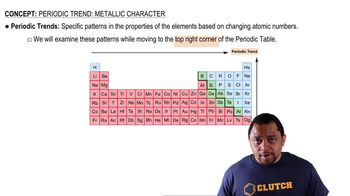
Trends in the Periodic Table
The periodic table exhibits specific trends in ionization energy, where elements in the same group have lower ionization energies than those in the same period. As you move from left to right across a period, ionization energy tends to increase due to the increasing positive charge of the nucleus, which attracts electrons more strongly. Conversely, moving down a group, ionization energy decreases because the outer electrons are further from the nucleus and experience greater shielding.
추천 영상:
가이드 코스
Periodic Trends
Comparison of Elements
When comparing elements like Si, F, In, and N, it is essential to consider their positions in the periodic table. Fluorine (F) has the highest ionization energy due to its small atomic size and high electronegativity, while indium (In) has the lowest due to its larger atomic radius and lower effective nuclear charge. Silicon (Si) and nitrogen (N) fall in between, with nitrogen having a higher ionization energy than silicon due to its position in the same period but further to the right.
추천 영상:
가이드 코스
Elemental Forms of Elements
관련 실천
교과서 질문
480
views
교과서 질문
Choose the element with the more negative (more exothermic) electron affinity from each pair. a. Na or Rb
2072
views
교과서 질문
Choose the element with the higher first ionization energy from each pair. c. As or At
491
views
교과서 질문
Consider this set of ionization energies. IE1 = 578 kJ/mol IE2 = 1820 kJ/mol IE3 = 2750 kJ/mol IE4 = 11,600 kJ/mol To which third-period element do these ionization values belong?
5849
views
1
comments
교과서 질문
Choose the element with the higher first ionization energy from each pair. a. P or I b. Si or Cl c. P or Sb d. Ga or Ge
1734
views
1
rank
교과서 질문
For each element, predict where the 'jump' occurs for successive ionization energies. (For example, does the jump occur between the first and second ionization energies, the second and third, or the third and fourth?) a. Be b. N c. O d. Li
3121
views