Ch.9 - Periodic Properties of the Elements
Tro - Chemistry: A Molecular Approach 5th Edition
Tro5th EditionChemistry: A Molecular ApproachISBN: 9780134874371당신이 사용하는 게 아니라요?교과서 변경
9장, 문제 84

Potassium is a highly reactive metal while argon is an inert gas. Explain this difference based on their electron configurations.

검증된 단계별 안내
1
Identify the electron configuration of potassium (K): Potassium has an atomic number of 19, so its electron configuration is 1s^2 2s^2 2p^6 3s^2 3p^6 4s^1.
Identify the electron configuration of argon (Ar): Argon has an atomic number of 18, so its electron configuration is 1s^2 2s^2 2p^6 3s^2 3p^6.
Explain the reactivity of potassium: Potassium has one electron in its outermost shell (4s^1), which it can easily lose to achieve a stable electron configuration similar to the noble gas argon. This makes potassium highly reactive.
Explain the inertness of argon: Argon has a complete outer electron shell (3s^2 3p^6), which makes it stable and unlikely to react with other elements.
Conclude the explanation: The difference in reactivity between potassium and argon is due to their electron configurations, where potassium seeks to lose an electron to achieve stability, while argon already has a stable configuration.

주요 개념

질문에 올바르게 답하기 위해 반드시 이해해야 하는 핵심 개념들은 다음과 같습니다.

Electron Configuration

Electron configuration describes the distribution of electrons in an atom's orbitals. It is represented using a notation that indicates the energy levels and sublevels occupied by electrons. Understanding electron configuration is crucial for predicting an element's chemical behavior, as it determines how an atom interacts with others during chemical reactions.
추천 영상:
가이드 코스
01:33
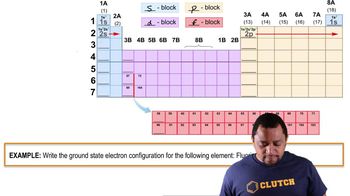
Electron Configuration Example

Reactivity of Metals

The reactivity of metals, such as potassium, is largely influenced by their electron configuration, particularly the number of valence electrons. Metals tend to lose electrons to achieve a stable electron configuration, often resembling that of the nearest noble gas. Potassium, with one valence electron, readily loses this electron, making it highly reactive.
추천 영상:
가이드 코스
03:12
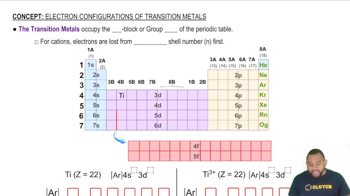
Transition Metals

Inert Gases and Stability

Inert gases, like argon, have complete outer electron shells, which makes them chemically stable and unreactive. Their electron configuration follows the octet rule, where having eight electrons in the outer shell leads to minimal tendency to form bonds. This stability is the reason why argon does not readily participate in chemical reactions, contrasting sharply with reactive metals.
추천 영상:
가이드 코스
03:13
Intepreting the Band of Stability