Ch.9 - Periodic Properties of the Elements
Tro - Chemistry: A Molecular Approach 5th Edition
Tro5th EditionChemistry: A Molecular ApproachISBN: 9780134874371당신이 사용하는 게 아니라요?교과서 변경
9장, 문제 51b

Which outer electron configuration would you expect to belong to a reactive nonmetal? a. ns2 b. ns2np6 c. ns2np5 d. ns2np2

검증된 단계별 안내
1
Identify the characteristics of a reactive nonmetal. Reactive nonmetals typically have high electronegativity and a strong tendency to gain electrons to achieve a stable electron configuration.
Consider the electron configurations provided: a. ns^2, b. ns^2np^6, c. ns^2np^5, d. ns^2np^2.
Recall that a stable electron configuration is often a full outer shell, which is ns^2np^6, corresponding to noble gases that are not reactive.
Recognize that a configuration of ns^2np^5 indicates one electron short of a full p subshell, making it highly reactive as it tends to gain one electron to achieve stability.
Conclude that the electron configuration ns^2np^5 is characteristic of a reactive nonmetal, as it is one electron away from achieving a stable noble gas configuration.

비슷한 문제에 대한 검증된 영상 답변:

이 영상 해법은 위 문제에 도움이 된다고 튜터들이 추천한 것입니다.
도움이 되었나요?

주요 개념

질문에 올바르게 답하기 위해 반드시 이해해야 하는 핵심 개념들은 다음과 같습니다.

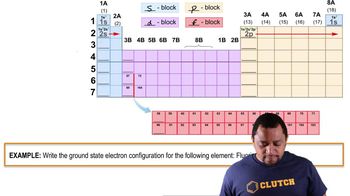
Electron Configuration

Electron configuration describes the distribution of electrons in an atom's orbitals. It is represented using the notation of subshells (s, p, d, f) and their respective electron counts. Understanding electron configuration is crucial for predicting an element's chemical properties, including its reactivity.
추천 영상:
가이드 코스
01:33
Electron Configuration Example

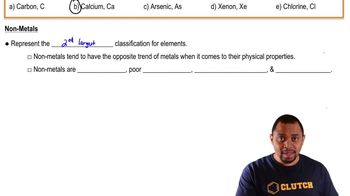
Reactivity of Nonmetals

Nonmetals are elements that typically gain electrons during chemical reactions, leading to the formation of anions. Their reactivity is largely influenced by their outer electron configuration, particularly the number of valence electrons. Nonmetals with nearly full outer shells tend to be more reactive as they seek to achieve a stable electron configuration.
추천 영상:
가이드 코스
01:12
Nonmetal Properties

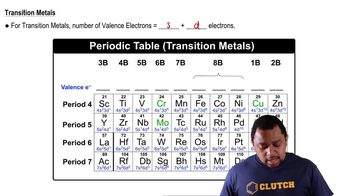
Valence Electrons

Valence electrons are the electrons in the outermost shell of an atom and are responsible for an element's chemical behavior. The number of valence electrons determines how an element interacts with others, including its tendency to gain, lose, or share electrons. For nonmetals, having five or more valence electrons typically indicates a higher reactivity.
추천 영상:
가이드 코스
02:12
Transition Metals Valence Electrons