Ch.9 - Periodic Properties of the Elements
Tro - Chemistry: A Molecular Approach 5th Edition
Tro5th EditionChemistry: A Molecular ApproachISBN: 9780134874371당신이 사용하는 게 아니라요?교과서 변경
9장, 문제 97

What are the general outer electron configurations (nsx npy) for groups 6A and 7A in the periodic table? The electron affinity of each group 7A element is more negative than that of each corresponding group 6A element. Use the electron configurations to explain why this is so.

검증된 단계별 안내
1
Identify the general outer electron configuration for group 6A elements, which is \( ns^2 np^4 \).
Identify the general outer electron configuration for group 7A elements, which is \( ns^2 np^5 \).
Understand that group 7A elements have one more electron in the p orbital compared to group 6A elements, making them one electron short of a full octet.
Recognize that group 7A elements have a strong tendency to gain an electron to achieve a stable noble gas configuration, resulting in a more negative electron affinity.
Explain that group 6A elements, while also tending to gain electrons, are less eager than group 7A elements because they need to gain two electrons to achieve a full octet, leading to a less negative electron affinity.

주요 개념

질문에 올바르게 답하기 위해 반드시 이해해야 하는 핵심 개념들은 다음과 같습니다.

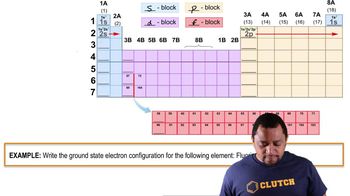
Electron Configuration

Electron configuration describes the distribution of electrons in an atom's orbitals. For main group elements, this is typically expressed in the form ns^x np^y, where 'n' indicates the principal energy level, and 's' and 'p' denote the types of orbitals. Understanding the electron configurations of elements in groups 6A and 7A is essential for predicting their chemical behavior and reactivity.
추천 영상:
가이드 코스
01:33
Electron Configuration Example

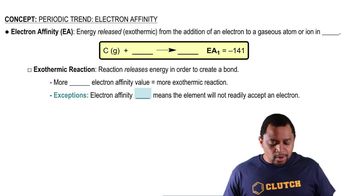
Electron Affinity

Electron affinity is the energy change that occurs when an electron is added to a neutral atom in the gas phase. A more negative electron affinity indicates a greater tendency for an atom to gain an electron. Group 7A elements, which have higher electron affinities than group 6A elements, are more likely to attract additional electrons due to their nearly filled p orbitals, making them more stable when gaining an electron.
추천 영상:
가이드 코스
01:34
Electron Affinity

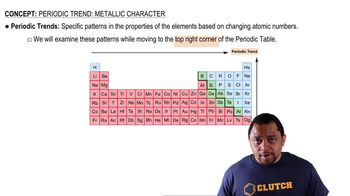
Periodic Trends

Periodic trends refer to predictable patterns in elemental properties across the periodic table, such as electronegativity, ionization energy, and electron affinity. As you move from left to right across a period, elements generally become more electronegative and have more negative electron affinities. This trend explains why group 7A elements, with their higher effective nuclear charge and electron configurations, have a stronger attraction for additional electrons compared to group 6A elements.
추천 영상:
가이드 코스
00:38
Periodic Trends