Ch.9 - Periodic Properties of the Elements
Tro - Chemistry: A Molecular Approach 5th Edition
Tro5th EditionChemistry: A Molecular ApproachISBN: 9780134874371당신이 사용하는 게 아니라요?교과서 변경
9장, 문제 9

Write the balanced chemical equation for the reaction between chlorine gas and fluorine gas.

검증된 단계별 안내
1
Identify the reactants: chlorine gas (Cl_2) and fluorine gas (F_2).
Determine the product: chlorine trifluoride (ClF_3) is a common product of this reaction.
Write the unbalanced chemical equation: Cl_2 + F_2 \(\rightarrow\) ClF_3.
Balance the equation by adjusting coefficients to ensure the same number of each type of atom on both sides of the equation.
Check the balance: Ensure that the number of Cl and F atoms are equal on both sides of the equation.

주요 개념

질문에 올바르게 답하기 위해 반드시 이해해야 하는 핵심 개념들은 다음과 같습니다.

Chemical Reactions

A chemical reaction involves the transformation of reactants into products through the breaking and forming of chemical bonds. In this case, chlorine gas (Cl2) and fluorine gas (F2) will react to form a new compound. Understanding the nature of reactants and products is essential for writing balanced chemical equations.
추천 영상:
가이드 코스
03:31
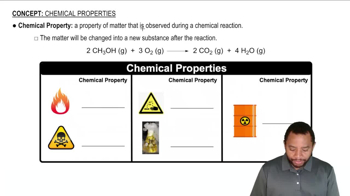
Chemical Properties

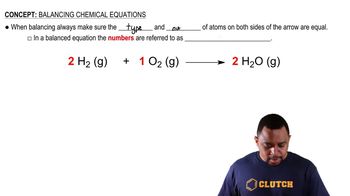
Balancing Chemical Equations

Balancing a chemical equation ensures that the number of atoms for each element is the same on both sides of the equation, adhering to the law of conservation of mass. This process involves adjusting coefficients in front of the chemical formulas to achieve balance. It is crucial for accurately representing the stoichiometry of the reaction.
추천 영상:
가이드 코스
01:32
Balancing Chemical Equations

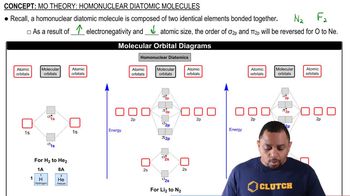
Diatomic Molecules

Certain elements, including chlorine and fluorine, naturally exist as diatomic molecules, meaning they are composed of two atoms. This is important when writing chemical equations, as the molecular forms of these elements must be used. Recognizing diatomic elements helps in correctly identifying the reactants in the reaction.
추천 영상:
가이드 코스
03:10
Homonuclear Diatomic Molecules