Ch.9 - Periodic Properties of the Elements
Tro - Chemistry: A Molecular Approach 5th Edition
Tro5th EditionChemistry: A Molecular ApproachISBN: 9780134874371당신이 사용하는 게 아니라요?교과서 변경
9장, 문제 42a

Write the full orbital diagram for each element. a. S

검증된 단계별 안내
1
1. Identify the atomic number of the element. The atomic number of Sulfur (S) is 16. This means there are 16 electrons in a neutral atom of sulfur.
2. Write the electron configuration for the element. The electron configuration of Sulfur (S) is 1s² 2s² 2p⁶ 3s² 3p⁴.
3. Draw the orbital diagram. Each orbital is represented by a box and each electron by an arrow. The arrows pointing up and down represent the electron spin.
4. Fill in the electrons. The 1s orbital gets 2 electrons, the 2s orbital gets 2 electrons, the 2p orbital gets 6 electrons, the 3s orbital gets 2 electrons, and the 3p orbital gets 4 electrons.
5. Remember the Pauli Exclusion Principle, which states that each orbital can hold a maximum of two electrons with opposite spins. Also, Hund's Rule states that electrons will fill an empty orbital in the same subshell before they pair up.

비슷한 문제에 대한 검증된 영상 답변:

이 영상 해법은 위 문제에 도움이 된다고 튜터들이 추천한 것입니다.
영상 길이:
2m
도움이 되었나요?

주요 개념

질문에 올바르게 답하기 위해 반드시 이해해야 하는 핵심 개념들은 다음과 같습니다.

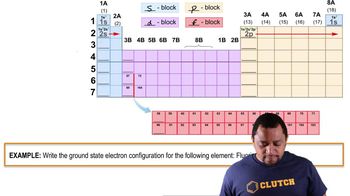
Electron Configuration

Electron configuration describes the distribution of electrons in an atom's orbitals. It follows the Aufbau principle, which states that electrons fill orbitals starting from the lowest energy level to the highest. For sulfur (S), with an atomic number of 16, the electron configuration is 1s² 2s² 2p⁶ 3s² 3p⁴, indicating how electrons are arranged in its orbitals.
추천 영상:
가이드 코스
01:33
Electron Configuration Example

Orbital Diagrams

Orbital diagrams visually represent the arrangement of electrons in an atom's orbitals. Each orbital can hold a maximum of two electrons with opposite spins, depicted as arrows pointing in opposite directions. For sulfur, the orbital diagram would show the filling of the 1s, 2s, 2p, 3s, and 3p orbitals, illustrating how electrons occupy these spaces.
추천 영상:
가이드 코스
01:16
Electron Orbital Diagrams

Hund's Rule

Hund's Rule states that electrons will fill degenerate orbitals (orbitals of the same energy) singly before pairing up. This minimizes electron-electron repulsion and stabilizes the atom. In the case of sulfur, the 3p orbitals will each receive one electron before any pairing occurs, leading to a more stable electron configuration.
추천 영상:
가이드 코스
00:28
Solubility Rules