Ch.1 - Matter, Measurement & Problem Solving
Tro - Chemistry: A Molecular Approach 6th Edition
Tro6th EditionChemistry: A Molecular ApproachISBN: 9780137832217당신이 사용하는 게 아니라요?교과서 변경
1장, 문제 42

Determine whether each molecular diagram represents a pure substance or a mixture. If it represents a pure substance, classify the substance as an element or a compound. If it represents a mixture, classify the mixture as homogeneous or heterogeneous.
Three molecular diagrams illustrating pure substances and mixtures for classification.

검증된 단계별 안내
1
Observe the molecular diagrams carefully to identify the types of particles present in each diagram.
For Diagram I, note that all particles are identical green spheres, indicating a pure substance. Since there is only one type of atom, classify it as an element.
For Diagram II, observe that there are two types of particles: red and yellow spheres bonded together in pairs. This indicates a pure substance composed of two different elements, classifying it as a compound.
For Diagram III, notice the presence of different types of particles: blue, black, purple, and grey spheres, some bonded and some not. This indicates a mixture. Since the particles are uniformly distributed, classify it as a homogeneous mixture.
Summarize the classifications: Diagram I is a pure substance (element), Diagram II is a pure substance (compound), and Diagram III is a homogeneous mixture.

비슷한 문제에 대한 검증된 영상 답변:

이 영상 해법은 위 문제에 도움이 된다고 튜터들이 추천한 것입니다.
영상 길이:
1m
도움이 되었나요?

주요 개념

질문에 올바르게 답하기 위해 반드시 이해해야 하는 핵심 개념들은 다음과 같습니다.

Pure Substances

A pure substance consists of only one type of particle, which can be either an element or a compound. Elements are made up of a single type of atom, while compounds consist of two or more different types of atoms chemically bonded together. In the molecular diagrams, pure substances will show uniformity in particle type and arrangement.
추천 영상:
가이드 코스
02:58
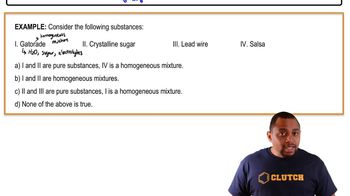
Classification of Matter Example

Mixtures

A mixture contains two or more different types of particles that are not chemically bonded. Mixtures can be classified as homogeneous, where the components are evenly distributed and indistinguishable, or heterogeneous, where the different components are easily identifiable. The arrangement of particles in the diagrams will help determine if a mixture is homogeneous or heterogeneous.
추천 영상:
가이드 코스
01:03
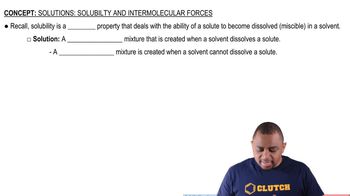
Solubility and Mixtures

Molecular Representation

Molecular diagrams visually represent the arrangement and types of particles in a substance. The colors and shapes of the particles in the diagrams indicate different elements or compounds. Analyzing these representations allows for the classification of substances as pure or mixtures, and further categorization into elements, compounds, homogeneous, or heterogeneous mixtures.
추천 영상:
가이드 코스
02:38
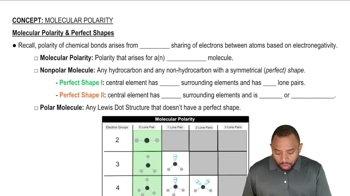
Molecular Polarity