A KNO3 solution containing 35 g of KNO3 per 100.0 g of water is cooled from 40 °C to 0 °C. What happens during cooling? (Use Figure 14.11.)
Ch.14 - Solutions

14장, 문제 51
Scuba divers breathing air at increased pressure can suffer from nitrogen narcosis—a condition resembling drunkenness—when the partial pressure of nitrogen exceeds about 4 atm. What property of gas-water solutions causes this to happen? How can a diver reverse this effect?
검증된 단계별 안내1
insert step 1> Understand that nitrogen narcosis is related to the solubility of gases in liquids, which is described by Henry's Law.
insert step 2> Recall Henry's Law, which states that the solubility of a gas in a liquid is directly proportional to the partial pressure of the gas above the liquid.
insert step 3> Recognize that as a diver descends, the pressure increases, leading to an increase in the partial pressure of nitrogen, which in turn increases its solubility in the diver's blood.
insert step 4> Understand that the increased solubility of nitrogen in the blood can affect the central nervous system, causing symptoms similar to drunkenness.
insert step 5> To reverse the effects of nitrogen narcosis, a diver should ascend to a shallower depth, reducing the pressure and thus the solubility of nitrogen in the blood.
주요 개념
질문에 올바르게 답하기 위해 반드시 이해해야 하는 핵심 개념들은 다음과 같습니다.
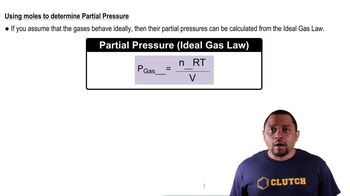
Partial Pressure
Partial pressure refers to the pressure exerted by a single component of a gas mixture. In the context of scuba diving, as a diver descends, the total pressure increases, which in turn raises the partial pressure of nitrogen in the air they breathe. When the partial pressure of nitrogen exceeds a certain threshold (around 4 atm), it can lead to nitrogen narcosis, affecting the diver's cognitive functions.
추천 영상:
가이드 코스
Partial Pressure Calculation
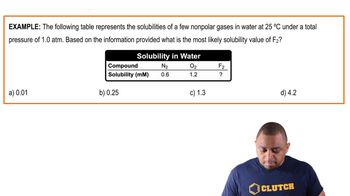
Gas Solubility in Liquids
The solubility of gases in liquids is influenced by factors such as temperature and pressure, described by Henry's Law. As the pressure increases, more gas can dissolve in the liquid (in this case, blood). For divers, the increased partial pressure of nitrogen leads to higher nitrogen solubility in their bloodstream, which can result in physiological effects like nitrogen narcosis when the concentration becomes too high.
추천 영상:
가이드 코스
Gas Solubility Example
Decompression and Ascent
To reverse the effects of nitrogen narcosis, divers must ascend slowly to reduce the pressure around them. This process, known as decompression, allows dissolved nitrogen to be released safely from the bloodstream. Rapid ascent can lead to decompression sickness, or 'the bends,' so controlled ascent is crucial for safely managing the nitrogen levels in the body.
관련 실천
교과서 질문
교과서 질문
Scuba divers breathing air at increased pressure can suffer from oxygen toxicity—too much oxygen in their bloodstream— when the partial pressure of oxygen exceeds about 1.4 atm. What happens to the amount of oxygen in a diver's bloodstream when he or she breathes oxygen at elevated pressures? How can this be reversed?
1102
views
교과서 질문
An aqueous NaCl solution is made using 102 g of NaCl diluted to a total solution volume of 1.00 L. Calculate the molarity of the solution. (Assume a density of 1.08 g>mL for the solution.)
교과서 질문
A KCl solution containing 38 g of KCl per 100.0 g of water is cooled from 60 °C to 0 °C. What happens during cooling? (Use Figure 14.11.)
1
views