Predict whether a precipitate will form if you mix 175.0 mL of a 0.0055 M KCl solution with 145.0 mL of a 0.0015 M AgNO3 solution, and identify the precipitate, if any.
검증된 단계별 안내
1
Calculate the moles of KCl in the solution using the formula: moles = concentration (M) \(\times\) volume (L).
Calculate the moles of AgNO3 in the solution using the formula: moles = concentration (M) \(\times\) volume (L).
Determine the total volume of the mixed solution by adding the volumes of the KCl and AgNO3 solutions.
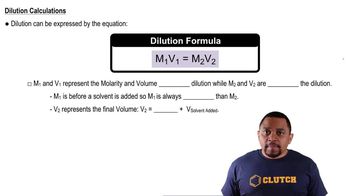
Calculate the concentrations of K^+ and Cl^- ions from KCl, and Ag^+ and NO3^- ions from AgNO3 in the mixed solution using the formula: concentration = moles / total volume (L).
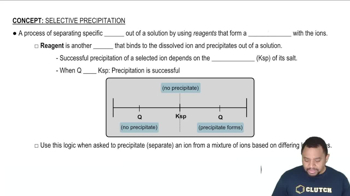
Use the solubility product constant (K_sp) for AgCl to determine if the product of the concentrations of Ag^+ and Cl^- ions exceeds K_sp, indicating the formation of a precipitate.
주요 개념
질문에 올바르게 답하기 위해 반드시 이해해야 하는 핵심 개념들은 다음과 같습니다.
Solubility Product Constant (Ksp)
The solubility product constant (Ksp) is a numerical value that represents the equilibrium between a solid and its ions in a saturated solution. It is specific to a particular ionic compound and helps predict whether a precipitate will form when two solutions are mixed. If the product of the concentrations of the ions in solution exceeds the Ksp, a precipitate will form.
Precipitation reactions occur when two soluble salts react in solution to form an insoluble salt, known as a precipitate. This process is driven by the formation of a compound that has low solubility in water. In this case, mixing KCl and AgNO3 can lead to the formation of AgCl, which is a common precipitate in such reactions.
Molarity is a measure of concentration defined as the number of moles of solute per liter of solution. When mixing solutions, the total volume changes, and the concentrations of the ions must be recalculated to determine if a precipitate will form. The dilution of the original solutions affects the final concentrations of K+ and Ag+ ions, which are crucial for assessing the potential for precipitation.


 검증된 단계별 안내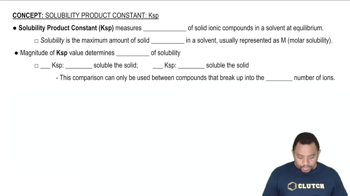
 01:47
01:47