Ch.6 - Gases
Tro - Chemistry: A Molecular Approach 6th Edition
Tro6th EditionChemistry: A Molecular ApproachISBN: 9780137832217당신이 사용하는 게 아니라요?교과서 변경
6장, 문제 55a

Write balanced complete ionic and net ionic equations for each reaction. a. HCl(aq) + LiOH(aq) → H2O(l) + LiCl(aq)

검증된 단계별 안내
1
Identify the reactants and products in the given chemical equation: HCl(aq) + LiOH(aq) \(\rightarrow\) H_2O(l) + LiCl(aq).
Write the balanced molecular equation: HCl(aq) + LiOH(aq) \(\rightarrow\) H_2O(l) + LiCl(aq).
Write the complete ionic equation by separating all strong electrolytes into their ions: H^+(aq) + Cl^-(aq) + Li^+(aq) + OH^-(aq) \(\rightarrow\) H_2O(l) + Li^+(aq) + Cl^-(aq).
Identify and cancel out the spectator ions, which appear on both sides of the complete ionic equation: Li^+(aq) and Cl^-(aq).
Write the net ionic equation by including only the ions and molecules directly involved in the reaction: H^+(aq) + OH^-(aq) \(\rightarrow\) H_2O(l).

비슷한 문제에 대한 검증된 영상 답변:

이 영상 해법은 위 문제에 도움이 된다고 튜터들이 추천한 것입니다.
도움이 되었나요?

주요 개념

질문에 올바르게 답하기 위해 반드시 이해해야 하는 핵심 개념들은 다음과 같습니다.

Complete Ionic Equation

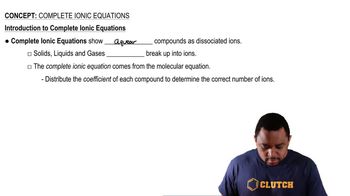
A complete ionic equation represents all the ions present in a solution during a chemical reaction. It shows the reactants and products in their ionic forms, highlighting the dissociation of soluble ionic compounds in aqueous solutions. This equation is essential for understanding how ions interact in solution and sets the stage for identifying the net ionic equation.
추천 영상:
가이드 코스
00:47
Complete Ionic Equations

Net Ionic Equation

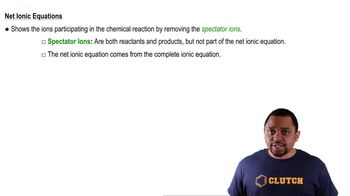
The net ionic equation simplifies the complete ionic equation by removing spectator ions—ions that do not participate in the actual chemical reaction. This equation focuses solely on the species that undergo a change, providing a clearer picture of the chemical process. It is particularly useful for emphasizing the essential components of a reaction and understanding the underlying chemistry.
추천 영상:
가이드 코스
00:51
Net Ionic Equations

Acid-Base Neutralization Reaction

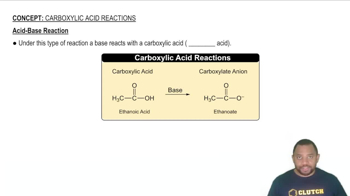
An acid-base neutralization reaction occurs when an acid reacts with a base to produce water and a salt. In the given reaction, hydrochloric acid (HCl) reacts with lithium hydroxide (LiOH), resulting in the formation of water (H2O) and lithium chloride (LiCl). Understanding this type of reaction is crucial for predicting the products and writing the corresponding ionic equations.
추천 영상:
가이드 코스
01:09
Acid-Base Reaction