Ch.7 - Thermochemistry
Tro - Chemistry: A Molecular Approach 6th Edition
Tro6th EditionChemistry: A Molecular ApproachISBN: 9780137832217당신이 사용하는 게 아니라요?교과서 변경
7장, 문제 62

Determine whether each process is exothermic or endothermic and indicate the sign of ΔH. a. dry ice evaporating b. a sparkler burning c. the reaction that occurs in a chemical cold pack used to ice athletic injuries

검증된 단계별 안내
1
Identify the nature of each process in terms of heat flow. Exothermic processes release heat to the surroundings, making the surroundings warmer, and have a negative ΔH. Endothermic processes absorb heat from the surroundings, making the surroundings cooler, and have a positive ΔH.
Analyze the process of dry ice evaporating: Dry ice sublimates, changing from solid to gas. This process requires heat absorption from the surroundings to overcome the lattice energy of the solid, indicating it is endothermic with a positive ΔH.
Consider the process of a sparkler burning: Burning, or combustion, typically releases heat as chemical bonds are broken and new bonds are formed, releasing more energy than is consumed. This process is exothermic with a negative ΔH.
Evaluate the reaction in a chemical cold pack: These packs usually contain substances like ammonium nitrate or ammonium chloride that dissolve in water within the pack. The dissolution is endothermic, absorbing heat from the surroundings (in this case, the injury) to facilitate the dissolving process, resulting in a positive ΔH.
Summarize the findings for each process with the appropriate sign of ΔH: Dry ice evaporating is endothermic (+ΔH), a sparkler burning is exothermic (-ΔH), and the reaction in a chemical cold pack is endothermic (+ΔH).

비슷한 문제에 대한 검증된 영상 답변:

이 영상 해법은 위 문제에 도움이 된다고 튜터들이 추천한 것입니다.
영상 길이:
4m
도움이 되었나요?

주요 개념

질문에 올바르게 답하기 위해 반드시 이해해야 하는 핵심 개념들은 다음과 같습니다.

Exothermic and Endothermic Processes

Exothermic processes release energy, usually in the form of heat, to the surroundings, resulting in a negative change in enthalpy (ΔH < 0). In contrast, endothermic processes absorb energy from the surroundings, leading to a positive change in enthalpy (ΔH > 0). Understanding these definitions is crucial for determining the nature of the processes described in the question.
추천 영상:
가이드 코스
01:23
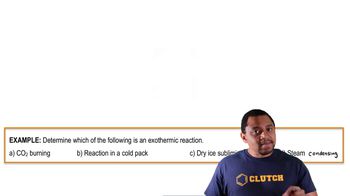
Endothermic & Exothermic Reactions Example 2

Phase Changes

Phase changes, such as evaporation or sublimation, involve the transition of a substance from one state of matter to another. For example, dry ice (solid CO2) sublimates directly to gas, which is an endothermic process as it requires energy input to overcome intermolecular forces. Recognizing the energy dynamics during phase changes helps in classifying them as exothermic or endothermic.
추천 영상:
가이드 코스
01:46
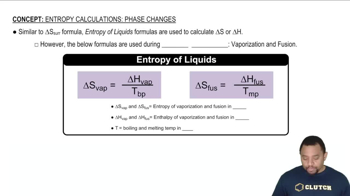
Entropy in Phase Changes

Chemical Reactions and Heat Transfer

Chemical reactions can either absorb or release heat, depending on the nature of the reactants and products. For instance, the combustion of a sparkler is an exothermic reaction that releases heat and light, while the reaction in a cold pack absorbs heat from the surroundings, making it endothermic. Understanding the heat transfer in chemical reactions is essential for determining the sign of ΔH.
추천 영상: