Ch.1 - Matter, Measurement & Problem Solving
Tro - Chemistry: A Molecular Approach 6th Edition
Tro6th EditionChemistry: A Molecular ApproachISBN: 9780137832217당신이 사용하는 게 아니라요?교과서 변경
1장, 문제 92a

Calculate to the correct number of significant figures. a. [(1.7×10⁶) / (2.63×10⁵)] + 7.33 b. (568.99 - 232.1) / 5.3

검증된 단계별 안내
1
Identify the operations involved: multiplication and addition.
Perform the multiplication: \((1.7 \times 10^6) \times (2.63 \times 10^5)\).
Determine the number of significant figures for the multiplication result. The number with the fewest significant figures is 1.7 (2 significant figures).
Add the result of the multiplication to 7.33. Ensure the addition is done with the correct number of decimal places based on the least precise measurement.
Express the final result with the correct number of significant figures, considering both the multiplication and addition steps.

비슷한 문제에 대한 검증된 영상 답변:

이 영상 해법은 위 문제에 도움이 된다고 튜터들이 추천한 것입니다.
영상 길이:
1m
도움이 되었나요?

주요 개념

질문에 올바르게 답하기 위해 반드시 이해해야 하는 핵심 개념들은 다음과 같습니다.

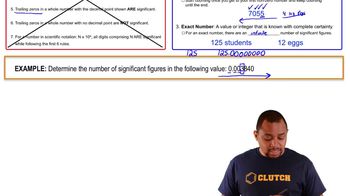
Significant Figures

Significant figures are the digits in a number that contribute to its precision. This includes all non-zero digits, any zeros between significant digits, and trailing zeros in the decimal portion. Understanding significant figures is crucial for accurately reporting measurements and calculations in chemistry, as it reflects the precision of the data used.
추천 영상:
가이드 코스
01:09
Significant Figures Example

Scientific Notation

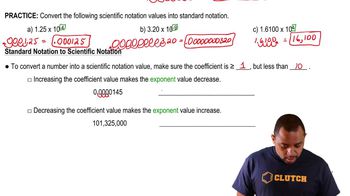
Scientific notation is a way of expressing numbers that are too large or too small to be conveniently written in decimal form. It is represented as a product of a number between 1 and 10 and a power of ten. This notation simplifies calculations, especially when dealing with very large or small quantities, which is common in chemistry.
추천 영상:
가이드 코스
02:50
Standard Notation to Scientific Notation

Order of Operations in Calculations

The order of operations is a set of rules that dictates the sequence in which calculations should be performed to ensure accurate results. In chemistry, this typically follows the PEMDAS/BODMAS rule (Parentheses, Exponents, Multiplication and Division, Addition and Subtraction). Correctly applying this order is essential when performing calculations involving addition, especially when combining numbers in scientific notation.
추천 영상:
가이드 코스
01:29
Bond Order Calculation