Ethylene glycol (antifreeze) has a density of 1.11 g>cm3. a. What is the mass in g of 226 mL of ethylene glycol? b. What is the volume in L of 4.2 kg of ethylene glycol?

Ch.1 - Matter, Measurement & Problem Solving

1장, 문제 71a
Ethylene glycol (antifreeze) has a density of 1.11 g>cm3. a. What is the mass in g of 226 mL of ethylene glycol? b. What is the volume in L of 4.2 kg of ethylene glycol?
검증된 단계별 안내1
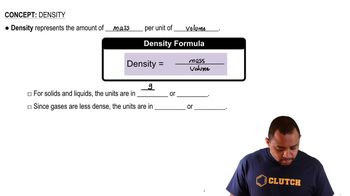
Step 1: Understand the relationship between mass, volume, and density. The formula to use is: \( \text{Density} = \frac{\text{Mass}}{\text{Volume}} \).
Step 2: For part (a), rearrange the formula to solve for mass: \( \text{Mass} = \text{Density} \times \text{Volume} \).
Step 3: Convert the volume from mL to cm³ for part (a), knowing that 1 mL = 1 cm³. Therefore, 226 mL = 226 cm³.
Step 4: Substitute the given values into the formula for part (a): \( \text{Mass} = 1.11 \text{ g/cm}^3 \times 226 \text{ cm}^3 \).
Step 5: For part (b), rearrange the formula to solve for volume: \( \text{Volume} = \frac{\text{Mass}}{\text{Density}} \). Convert the mass from kg to g (1 kg = 1000 g), so 4.2 kg = 4200 g, and then substitute into the formula: \( \text{Volume} = \frac{4200 \text{ g}}{1.11 \text{ g/cm}^3} \). Convert the result from cm³ to L (1 L = 1000 cm³).

비슷한 문제에 대한 검증된 영상 답변:
이 영상 해법은 위 문제에 도움이 된다고 튜터들이 추천한 것입니다.
영상 길이:
1m주요 개념
질문에 올바르게 답하기 위해 반드시 이해해야 하는 핵심 개념들은 다음과 같습니다.
Density
Density is defined as the mass of a substance per unit volume, typically expressed in grams per cubic centimeter (g/cm³) or kilograms per liter (kg/L). It is a crucial property that helps in determining how much mass is contained in a given volume of a substance. In this question, the density of ethylene glycol is used to calculate the mass from a known volume and vice versa.
추천 영상:
가이드 코스
Density Concepts
Mass-Volume Relationship
The mass-volume relationship is a fundamental concept in chemistry that describes how mass and volume are interrelated through density. The formula used is mass = density × volume. This relationship allows for the conversion between mass and volume when the density of a substance is known, which is essential for solving the parts of the question regarding ethylene glycol.
추천 영상:
가이드 코스
Relationship of Volume and Moles Example
Unit Conversion
Unit conversion is the process of converting a quantity expressed in one set of units to another. In this question, it is necessary to convert between milliliters (mL) and liters (L) as well as between grams (g) and kilograms (kg). Understanding how to perform these conversions is vital for accurately answering the question and ensuring that all measurements are in compatible units.
추천 영상:
가이드 코스
Conversion Factors
관련 실천
교과서 질문
교과서 질문
A supposedly gold nugget displaces 19.3 mL of water and has a mass of 371 g. Could the nugget be made of gold?
1093
views
교과서 질문
A titanium bicycle frame displaces 0.314 L of water and has a mass of 1.41 kg. What is the density of the titanium in g/cm3?
1744
views
교과서 질문
A small airplane takes on 245 L of fuel. If the density of the fuel is 0.821 g/mL, what mass of fuel has the airplane taken on?
2438
views
교과서 질문
Glycerol is a syrupy liquid often used in cosmetics and soaps. A 3.25 L sample of pure glycerol has a mass of 4.10×10³ g. What is the density of glycerol in g/cm3?
1503
views
교과서 질문
Acetone (nail polish remover) has a density of 0.7857 g>cm3. a. What is the mass in g of 12.55 mL of acetone? b. What is the volume in mL of 9.12 g of acetone?
1
views