Use the prefix multipliers to express each measurement without exponents. b. 11 * 10 - 12 s

Ch.1 - Matter, Measurement & Problem Solving

1장, 문제 56
The warmest temperature ever measured in the United States is 134 °F, recorded on July 10, 1913, in Death Valley, California. Convert that temperature to °C and K.
검증된 단계별 안내1
First, convert the temperature from Fahrenheit (°F) to Celsius (°C) using the formula: \( C = \frac{5}{9} \times (F - 32) \), where \( F \) is the temperature in Fahrenheit.
Substitute 134 °F into the formula to find the temperature in Celsius.
Next, convert the temperature from Celsius (°C) to Kelvin (K) using the formula: \( K = C + 273.15 \), where \( C \) is the temperature in Celsius.
Substitute the result from step 2 into the formula to find the temperature in Kelvin.
Ensure to check the units in your final answers to confirm they are in °C and K respectively.

비슷한 문제에 대한 검증된 영상 답변:
이 영상 해법은 위 문제에 도움이 된다고 튜터들이 추천한 것입니다.
영상 길이:
2m주요 개념
질문에 올바르게 답하기 위해 반드시 이해해야 하는 핵심 개념들은 다음과 같습니다.
Temperature Scales
Temperature can be measured in different scales, primarily Celsius (°C), Fahrenheit (°F), and Kelvin (K). Each scale has its own zero point and degree increments. Understanding how these scales relate to one another is essential for converting temperatures accurately.
추천 영상:
가이드 코스
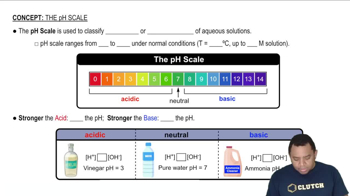
The pH Scale
Conversion Formulas
To convert temperatures between Fahrenheit and Celsius, the formula is °C = (°F - 32) × 5/9. For converting Celsius to Kelvin, the formula is K = °C + 273.15. Mastery of these formulas is crucial for performing temperature conversions correctly.
추천 영상:
가이드 코스
Conversion Factors
Absolute Zero
Kelvin is an absolute temperature scale where 0 K represents absolute zero, the theoretical point where molecular motion ceases. This scale is used in scientific contexts because it provides a direct measure of thermal energy. Understanding this concept helps in grasping the significance of temperature in physical sciences.
추천 영상:
가이드 코스
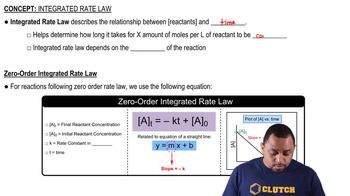
Zero-Order Reactions
관련 실천
교과서 질문
교과서 질문
Based on the molecular diagram, classify each change as physical or chemical.
2821
views
교과서 질문
Use prefix multipliers to express each measurement without exponents. a. 3.4x10⁻¹⁶m
교과서 질문
Convert each temperature. a. 32 °F to °C (temperature at which water freezes) b. 77 K to °F (temperature of liquid nitrogen) c. -109 °F to °C (temperature of dry ice) d. 98.6 °F to K (body temperature)
644
views
교과서 질문
Classify each change as physical or chemical. a. Natural gas burns in a stove. b. The liquid propane in a gas grill evaporates because the valve was left open. c. The liquid propane in a gas grill burns in a flame. d. A bicycle frame rusts on repeated exposure to air and water.
863
views
교과서 질문
Use the prefix multipliers to express each measurement without exponents. c. 7.4 * 103 g