Ch.10 - Chemical Bonding I: The Lewis Model
Tro - Chemistry: A Molecular Approach 6th Edition
Tro6th EditionChemistry: A Molecular ApproachISBN: 9780137832217당신이 사용하는 게 아니라요?교과서 변경
10장, 문제 41

Use Lewis symbols to determine the formula for the compound that forms between each pair of elements. a. Mg and S b. Sr and Br c. K and Se d. Al and S

검증된 단계별 안내
1
Identify the valence electrons for each element using their group number on the periodic table. For example, Mg is in Group 2 and thus has 2 valence electrons, while S is in Group 16 and has 6 valence electrons.
Determine the total number of electrons each element needs to achieve a stable octet (8 electrons in the outer shell). For instance, Mg needs 6 more electrons to complete its octet, and S needs 2 more electrons.
Decide how the elements can share or transfer electrons to achieve stable octets. For example, Mg can lose 2 electrons to form Mg2+, and S can gain 2 electrons to form S2-.
Combine the ions in a ratio that balances the total positive and negative charges to form a neutral compound. For Mg2+ and S2-, the ratio is 1:1, resulting in the formula MgS.
Repeat the above steps for each pair of elements: Sr and Br, K and Se, Al and S, to determine the formulas SrBr2, K2Se, and Al2S3 respectively, based on their electron transfers and the charges of the resulting ions.

비슷한 문제에 대한 검증된 영상 답변:

이 영상 해법은 위 문제에 도움이 된다고 튜터들이 추천한 것입니다.
영상 길이:
1m
도움이 되었나요?

주요 개념

질문에 올바르게 답하기 위해 반드시 이해해야 하는 핵심 개념들은 다음과 같습니다.

Lewis Symbols

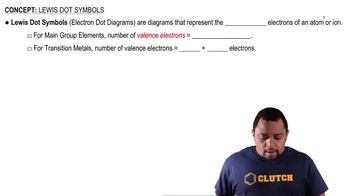
Lewis symbols, or Lewis dot structures, represent the valence electrons of an atom as dots around the element's symbol. This visual representation helps in understanding how atoms bond with each other by either sharing or transferring electrons. In the context of ionic and covalent bonding, Lewis symbols are essential for predicting the formation of compounds between different elements.
추천 영상:
가이드 코스
00:52
Lewis Dot Symbols

Ionic and Covalent Bonds

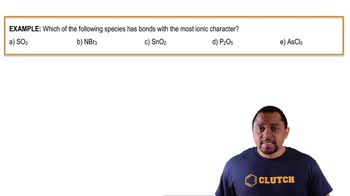
Ionic bonds form when one atom donates electrons to another, resulting in the creation of charged ions that attract each other. In contrast, covalent bonds involve the sharing of electrons between atoms. Understanding the nature of the bond formed between elements, such as metals and nonmetals, is crucial for determining the correct formula of the resulting compound.
추천 영상:
가이드 코스
01:16
Chemical Bonds Example 1

Periodic Table Trends

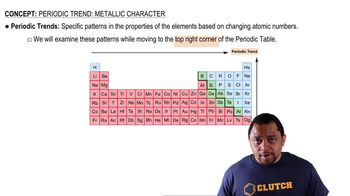
The periodic table organizes elements based on their atomic number and properties, revealing trends in electronegativity, ionization energy, and atomic size. These trends help predict how elements will interact with each other, particularly in terms of electron transfer or sharing. Recognizing these trends is vital for accurately determining the formulas of compounds formed between different pairs of elements.
추천 영상:
가이드 코스
00:38
Periodic Trends