Ch.10 - Chemical Bonding I: The Lewis Model
Tro - Chemistry: A Molecular Approach 6th Edition
Tro6th EditionChemistry: A Molecular ApproachISBN: 9780137832217당신이 사용하는 게 아니라요?교과서 변경
10장, 문제 62a

Draw the Lewis structure for ClF with an arrow representing the dipole moment.

검증된 단계별 안내
1
Identify the total number of valence electrons: Chlorine (Cl) has 7 valence electrons and Fluorine (F) also has 7 valence electrons, making a total of 14 valence electrons.
Determine the central atom: In a diatomic molecule like ClF, there is no central atom, so we will arrange Cl and F linearly.
Draw a single bond between Cl and F: This bond will use 2 of the 14 valence electrons, leaving us with 12 valence electrons.
Distribute the remaining electrons to satisfy the octet rule: Place 6 electrons (3 lone pairs) around each atom to complete their octets.
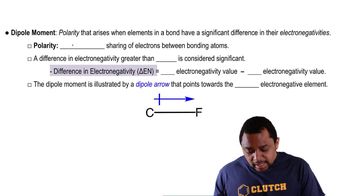
Indicate the dipole moment: Since fluorine is more electronegative than chlorine, draw an arrow pointing from Cl to F, indicating the direction of the dipole moment.

비슷한 문제에 대한 검증된 영상 답변:

이 영상 해법은 위 문제에 도움이 된다고 튜터들이 추천한 것입니다.
영상 길이:
2m

주요 개념

질문에 올바르게 답하기 위해 반드시 이해해야 하는 핵심 개념들은 다음과 같습니다.

Lewis Structures

Lewis structures are diagrams that represent the bonding between atoms in a molecule and the lone pairs of electrons that may exist. They use dots to represent valence electrons and lines to represent bonds between atoms. Understanding how to draw Lewis structures is essential for visualizing molecular geometry and predicting the behavior of molecules.
추천 영상:
가이드 코스
04:28
Lewis Dot Structures: Ions

Electronegativity

Electronegativity is a measure of an atom's ability to attract and hold onto electrons in a chemical bond. In the case of ClF, chlorine and fluorine have different electronegativities, with fluorine being more electronegative. This difference leads to the formation of a polar bond, where the electron density is unevenly distributed, resulting in a dipole moment.
추천 영상:
가이드 코스
02:10
Electronegativity Trends

Dipole Moment

A dipole moment is a vector quantity that represents the separation of positive and negative charges in a molecule. It is indicated by an arrow pointing from the positive end to the negative end of the bond. In ClF, the dipole moment arises due to the difference in electronegativity between chlorine and fluorine, which creates a polar bond and influences the molecule's overall polarity.
추천 영상: