Order these compounds in order of increasing carbon–carbon bond strength: HCCH, H2CCH2, H3CCH3.
Ch.10 - Chemical Bonding I: The Lewis Model

10장, 문제 86
Which of the two compounds, H2NNH2 and HNNH, has the strongest nitrogen-nitrogen bond, and which has the shorter nitrogen-nitrogen bond.
검증된 단계별 안내1
Step 1: Identify the type of bonds in each compound. In H2NNH2, the nitrogen atoms are connected by a single bond. In HNNH, the nitrogen atoms are connected by a triple bond.
Step 2: Understand the relationship between bond strength and bond length. Generally, the stronger the bond, the shorter the bond length. This is because stronger bonds pull the atoms closer together.
Step 3: Apply this understanding to the compounds in question. The triple bond in HNNH is stronger than the single bond in H2NNH2, so HNNH has the stronger nitrogen-nitrogen bond.
Step 4: Similarly, because the bond in HNNH is stronger, it is also shorter. Therefore, HNNH has the shorter nitrogen-nitrogen bond.
Step 5: In conclusion, HNNH has both the stronger and the shorter nitrogen-nitrogen bond compared to H2NNH2.

비슷한 문제에 대한 검증된 영상 답변:
이 영상 해법은 위 문제에 도움이 된다고 튜터들이 추천한 것입니다.
영상 길이:
6m주요 개념
질문에 올바르게 답하기 위해 반드시 이해해야 하는 핵심 개념들은 다음과 같습니다.
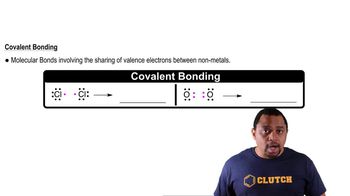
Covalent Bonding
Covalent bonding occurs when two atoms share electrons to achieve a full outer shell, leading to the formation of molecules. The strength of a covalent bond is influenced by factors such as the number of shared electron pairs and the electronegativity of the atoms involved. In the case of nitrogen-nitrogen bonds, the presence of lone pairs and the overall molecular structure can significantly affect bond strength.
추천 영상:
가이드 코스
Chemical Bonds
Bond Length
Bond length is the distance between the nuclei of two bonded atoms. It is influenced by the size of the atoms and the type of bond formed. Generally, shorter bonds are stronger due to the increased overlap of atomic orbitals, which leads to a more stable interaction. In nitrogen compounds, variations in hybridization and steric effects can alter bond lengths.
추천 영상:
가이드 코스
Average Bond Order
Resonance Structures
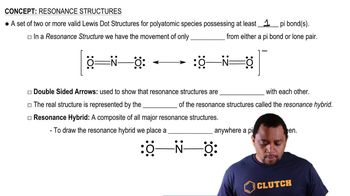
Resonance structures are different ways of drawing a molecule that can represent the same arrangement of atoms but differ in the distribution of electrons. These structures help explain the delocalization of electrons in molecules, which can affect bond strength and length. In compounds like H2NNH2 and HNNH, resonance can influence the nitrogen-nitrogen bond characteristics, leading to variations in stability and bond properties.
추천 영상:
가이드 코스
Resonance Structures
관련 실천
교과서 질문
1441
views
교과서 질문
Ethanol is a possible fuel. Use average bond energies to calculate ΔHrxn for the combustion of ethanol. CH3CH2OH(g) + 3 O2(g) → 2 CO2(g) + 3 H2O(g)
2906
views
교과서 질문
Order these compounds in order of decreasing carbon–carbon bond length: HCCH, H2CCH2, H3CCH3.
1708
views
1
rank
교과서 질문
Ethane burns in air to form carbon dixode and water vapor.
2 H3C¬CH3( g) + 7 O2( g)¡4 CO2( g) + 6 H2O( g)
Use average bond energies to calculate ΔHrxn for the reaction.
2
views
교과서 질문
Write Lewis structures for each molecule or ion. Use expanded octets as necessary. b. AsF6-
534
views
교과서 질문
Hydrogenation reactions are used to add hydrogen across double bonds in hydrocarbons and other organic compounds. Use average bond energies to calculate ΔHrxn for the hydrogenation reaction. H2C=CH2(g) + H2(g) → H3C–CH3(g)
2669
views
1
rank