Determine the molecular geometry and sketch each molecule or ion, using the bond conventions shown in “Representing Molecular Geometries on Paper” in Section 11.4. d. IF2–

Ch.11 - Chemical Bonding II: Molecular Shapes, VSEPR & MO Theory

11장, 문제 39d
Determine the molecular geometry and sketch each molecule or ion using the bond conventions shown in “Representing Molecular Geometries on Paper” in Section 11.4. d. BrF5
검증된 단계별 안내1
Identify the central atom in the molecule. For BrF5, bromine (Br) is the central atom.
Determine the total number of valence electrons. Bromine has 7 valence electrons, and each fluorine has 7 valence electrons. Since there are 5 fluorine atoms, the total is 7 + (5 * 7) = 42 valence electrons.
Draw the Lewis structure. Place Br in the center and arrange the 5 F atoms around it. Connect each F to Br with a single bond, using 10 electrons (5 bonds * 2 electrons each).
Distribute the remaining electrons to satisfy the octet rule. Place 3 lone pairs (6 electrons) on each F atom, using 30 electrons. The remaining 2 electrons form a lone pair on Br.
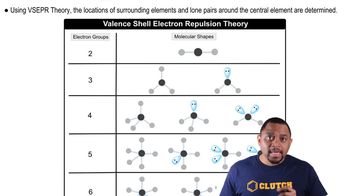
Determine the molecular geometry using VSEPR theory. With 5 bonding pairs and 1 lone pair on Br, the electron geometry is octahedral, and the molecular geometry is square pyramidal.

비슷한 문제에 대한 검증된 영상 답변:
이 영상 해법은 위 문제에 도움이 된다고 튜터들이 추천한 것입니다.
영상 길이:
1m도움이 되었나요?
주요 개념
질문에 올바르게 답하기 위해 반드시 이해해야 하는 핵심 개념들은 다음과 같습니다.
VSEPR Theory
Valence Shell Electron Pair Repulsion (VSEPR) Theory is a model used to predict the geometry of individual molecules based on the repulsion between electron pairs in the valence shell of the central atom. According to VSEPR, electron pairs will arrange themselves as far apart as possible to minimize repulsion, which helps determine the molecular shape.
추천 영상:
가이드 코스
Molecular Shapes and VSEPR
Molecular Geometry
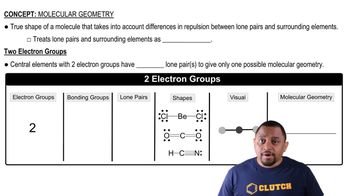
Molecular geometry refers to the three-dimensional arrangement of atoms within a molecule. It is influenced by the number of bonding pairs and lone pairs of electrons around the central atom. For example, in BrF5, the presence of five fluorine atoms and one lone pair on bromine leads to a square pyramidal geometry.
추천 영상:
가이드 코스
Molecular Geometry with Two Electron Groups
Bonding Conventions
Bonding conventions are standardized methods for representing molecular structures on paper, including the use of lines to depict bonds and symbols for lone pairs. These conventions help visualize the arrangement of atoms and electron pairs, which is essential for accurately sketching the molecular geometry of compounds like BrF5.
추천 영상:
가이드 코스
Bond Angles
관련 실천
교과서 질문
교과서 질문
Which species has the smaller bond angle, ClO4- or ClO3- ? Explain.
998
views
교과서 질문
Determine the molecular geometry and sketch each molecule or ion using the bond conventions shown in “Representing Molecular Geometries on Paper” in Section 11.4. c. PCl5
교과서 질문
Which species has the smaller bond angle, H3O+ or H2O? Explain.
1068
views
교과서 질문
Determine the molecular geometry and sketch each molecule or ion, using the bond conventions shown in “Representing Molecular Geometries on Paper” in Section 11.4. c. ClF3
교과서 질문
Determine the molecular geometry and sketch each molecule or ion, using the bond conventions shown in “Representing Molecular Geometries on Paper” in Section 11.4. b. SCl4