The density of an unknown metal is 12.3 g/cm3, and its atomic radius is 0.134 nm. It has a face-centered cubic lattice. Find the atomic mass of this metal
Ch.13 - Solids & Modern Materials

13장, 문제 87
An unknown metal is found to have a density of 7.8748 g/cm3 and to crystallize in a body-centered cubic lattice. The edge of the unit cell is 0.28664 nm. Calculate the atomic mass of the metal.
검증된 단계별 안내1
Convert the edge length of the unit cell from nanometers to centimeters by using the conversion factor: 1 nm = 1 x 10^{-7} cm.
Calculate the volume of the unit cell using the formula for the volume of a cube: V = a^3, where 'a' is the edge length in centimeters.
Determine the mass of the unit cell by multiplying the volume of the unit cell by the density of the metal: mass = density x volume.
In a body-centered cubic (BCC) lattice, there are 2 atoms per unit cell. Use this information to find the mass of a single atom by dividing the mass of the unit cell by 2.
Calculate the atomic mass of the metal by converting the mass of a single atom from grams to atomic mass units (amu) using the conversion factor: 1 amu = 1.66053906660 x 10^{-24} g.

비슷한 문제에 대한 검증된 영상 답변:
이 영상 해법은 위 문제에 도움이 된다고 튜터들이 추천한 것입니다.
주요 개념
질문에 올바르게 답하기 위해 반드시 이해해야 하는 핵심 개념들은 다음과 같습니다.
Density and its Calculation
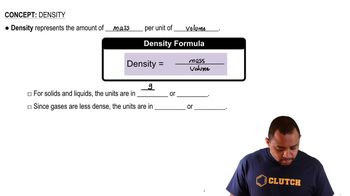
Density is defined as mass per unit volume, typically expressed in grams per cubic centimeter (g/cm³). To calculate the density of a substance, one can use the formula: density = mass/volume. In this context, knowing the density of the metal allows us to relate it to the atomic mass and the volume of the unit cell.
추천 영상:
가이드 코스
Density Concepts
Body-Centered Cubic (BCC) Lattice
A body-centered cubic lattice is a type of crystal structure where atoms are located at each corner of a cube and one atom is positioned at the center of the cube. This arrangement affects the packing efficiency and the volume occupied by the atoms, which is crucial for calculating the atomic mass based on the unit cell dimensions.
추천 영상:
가이드 코스
Body Centered Cubic Example
Unit Cell Volume and Atomic Mass Relationship
The volume of a unit cell can be calculated using the edge length of the cube, raised to the third power (V = a³). In a BCC structure, there are two atoms per unit cell, and the relationship between the mass of the atoms, the density, and the volume of the unit cell can be used to derive the atomic mass of the metal using the formula: atomic mass = (density × unit cell volume) / number of atoms per unit cell.
추천 영상:
가이드 코스
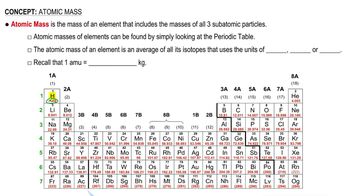
Atomic Mass
관련 실천
교과서 질문
2320
views
교과서 질문
Copper iodide crystallizes in the zinc blende structure. The sep- aration between nearest neighbor cations and anions is approximately 311 pm, and the melting point is 606 °C. Potassium chloride, by contrast, crystallizes in the rock salt structure. Even though the separation between nearest-neighbor cations and anions is greater (319 pm), the melting point of potassium chlo- ride is higher (776 °C). Explain.
472
views
교과서 질문
X-ray diffractometers often use metals that have had their core electrons excited as a source of X-rays. Consider the 2p → 1s transition for copper, which is called the K⍺ transition. Calculate the wavelength of X-rays (in Å) given off by the K⍺ transition if the energy given off by a mole of copper atoms is 7.77⨉105 kJ.(1Å = 10-10 m)
303
views