
Ch.14 - Solutions
Tro - Chemistry: A Molecular Approach 6th Edition
Tro6th EditionChemistry: A Molecular ApproachISBN: 9780137832217당신이 사용하는 게 아니라요?교과서 변경
14장, 문제 131

A 100.0-mL aqueous sodium chloride solution is 13.5% NaCl by mass and has a density of 1.12 g/mL. What would you add (solute or solvent) and what mass of it to make the boiling point of the solution 104.4 °C? (Use i = 1.8 for NaCl.)

검증된 단계별 안내
1
Use the density and volume of the solution to find its mass. The formula is: \( \text{mass of solution} = \text{density} \times \text{volume} \).
Use the percentage by mass to find the mass of NaCl. The formula is: \( \text{mass of NaCl} = \text{mass of solution} \times \frac{13.5}{100} \).
First, find the mass of water by subtracting the mass of NaCl from the total mass of the solution. Then, convert the mass of water to kilograms. Finally, calculate the molality using: \( \text{molality} = \frac{\text{moles of NaCl}}{\text{mass of water in kg}} \).
The formula is: \( \Delta T_b = i \cdot K_b \cdot m \), where \( \Delta T_b \) is the change in boiling point, \( i \) is the van 't Hoff factor, \( K_b \) is the ebullioscopic constant for water (0.512 °C/m), and \( m \) is the molality. Set \( \Delta T_b = 104.4 - 100 \) and solve for the new molality.
Determine whether to add solute (NaCl) or solvent (water) to reach the calculated molality. Calculate the mass of the solute or solvent needed to achieve this change.>

비슷한 문제에 대한 검증된 영상 답변:

이 영상 해법은 위 문제에 도움이 된다고 튜터들이 추천한 것입니다.
영상 길이:
5m
도움이 되었나요?

주요 개념

질문에 올바르게 답하기 위해 반드시 이해해야 하는 핵심 개념들은 다음과 같습니다.

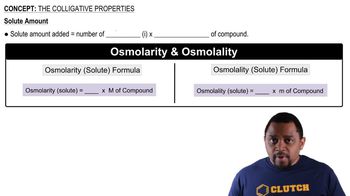
Colligative Properties

Colligative properties are physical properties of solutions that depend on the number of solute particles in a given amount of solvent, rather than the identity of the solute. These properties include boiling point elevation, freezing point depression, vapor pressure lowering, and osmotic pressure. In this question, the boiling point elevation is crucial for determining how much solute or solvent to add to achieve the desired boiling point.
추천 영상:
가이드 코스
01:26
Colligative Properties

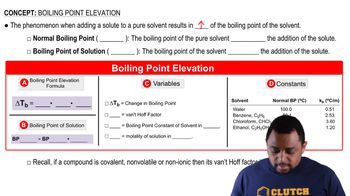
Boiling Point Elevation Formula

The boiling point elevation can be calculated using the formula ΔT_b = i * K_b * m, where ΔT_b is the change in boiling point, i is the van 't Hoff factor (which accounts for the number of particles the solute dissociates into), K_b is the ebullioscopic constant of the solvent, and m is the molality of the solution. For sodium chloride (NaCl), i is 2 because it dissociates into two ions: Na⁺ and Cl⁻. This formula is essential for calculating how much solute is needed to reach the target boiling point.
추천 영상:
가이드 코스
03:05
Boiling Point Elevation

Density and Mass Calculations

Density is defined as mass per unit volume and is crucial for converting between mass and volume in solution calculations. In this problem, the density of the sodium chloride solution (1.12 g/mL) allows us to determine the mass of the solution from its volume (100.0 mL). Understanding how to manipulate density and mass is vital for calculating the total mass of solute or solvent needed to achieve the desired boiling point.
추천 영상:
가이드 코스
03:12
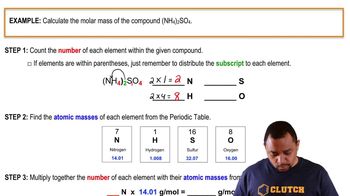
Molar Mass Calculation Example