
Ch.14 - Solutions
Tro - Chemistry: A Molecular Approach 6th Edition
Tro6th EditionChemistry: A Molecular ApproachISBN: 9780137832217당신이 사용하는 게 아니라요?교과서 변경
14장, 문제 82

A solution of methanol and water has a mole fraction of water of 0.312 and a total vapor pressure of 211 torr at 39.9 °C. The vapor pressures of pure methanol and pure water at this temperature are 256 torr and 55.3 torr, respectively. Is the solution ideal? If not, what can be inferred about the relative strengths of the solute–solvent interactions compared to the solute–solute and solvent–solvent interactions?

검증된 단계별 안내
1
Identify the components of the solution: methanol and water.
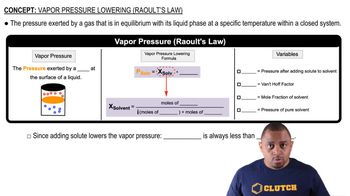
Use Raoult's Law to calculate the expected vapor pressure of the solution if it were ideal. Raoult's Law states that the partial vapor pressure of each component in an ideal solution is equal to the vapor pressure of the pure component multiplied by its mole fraction in the solution.
Calculate the partial vapor pressure of methanol: \( P_{\text{methanol}} = X_{\text{methanol}} \times P^0_{\text{methanol}} \), where \( X_{\text{methanol}} = 1 - X_{\text{water}} \).
Calculate the partial vapor pressure of water: \( P_{\text{water}} = X_{\text{water}} \times P^0_{\text{water}} \).
Add the partial pressures of methanol and water to find the total vapor pressure of the ideal solution and compare it to the given total vapor pressure to determine if the solution is ideal. If the calculated total vapor pressure is different from the given total vapor pressure, the solution is not ideal, indicating that the solute-solvent interactions differ in strength from the solute-solute and solvent-solvent interactions.

주요 개념

질문에 올바르게 답하기 위해 반드시 이해해야 하는 핵심 개념들은 다음과 같습니다.

Raoult's Law

Raoult's Law states that the vapor pressure of a solvent in a solution is equal to the vapor pressure of the pure solvent multiplied by its mole fraction in the solution. This law applies to ideal solutions, where the interactions between different molecules are similar to those between like molecules. Deviations from Raoult's Law can indicate non-ideal behavior, which is crucial for analyzing the vapor pressure of the methanol-water solution.
추천 영상:
가이드 코스
02:40
Raoult's Law and Vapor Pressure

Ideal vs. Non-Ideal Solutions

An ideal solution is one where the solute-solvent interactions are similar in strength to the solvent-solvent and solute-solute interactions, leading to predictable behavior according to Raoult's Law. Non-ideal solutions exhibit deviations from this behavior, often due to stronger or weaker interactions between solute and solvent molecules compared to their respective pure states. Understanding these differences helps in assessing the nature of the solution in question.
추천 영상:
가이드 코스
01:15
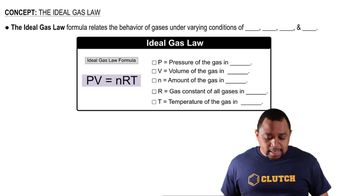
Ideal Gas Law Formula

Vapor Pressure and Intermolecular Forces

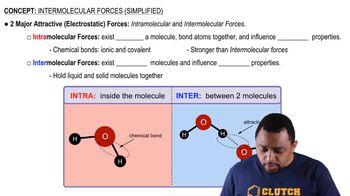
Vapor pressure is influenced by the strength of intermolecular forces within a liquid. Stronger intermolecular forces result in lower vapor pressures, as more energy is required for molecules to escape into the vapor phase. In the context of the methanol-water solution, comparing the observed vapor pressure to the expected value from Raoult's Law can provide insights into the relative strengths of solute-solvent interactions versus solvent-solvent and solute-solute interactions.
추천 영상:
가이드 코스
01:59
Intermolecular vs Intramolecular Forces