When lithium iodide (LiI) is dissolved in water, the solution becomes hotter. a. Is the dissolution of lithium iodide endothermic or exothermic?
Ch.14 - Solutions

14장, 문제 35
For each compound, would you expect greater solubility in water or in hexane? Indicate the kinds of intermolecular forces that occur between the solute and the solvent in which the molecule is most soluble. a. glucose
검증된 단계별 안내1
Identify the polarity of glucose and hexane. Glucose is a polar molecule due to its numerous hydroxyl (OH) groups that can form hydrogen bonds. Hexane, on the other hand, is a nonpolar hydrocarbon with only London dispersion forces.
Consider the solubility principle 'like dissolves like'. Polar solutes tend to dissolve better in polar solvents, and nonpolar solutes dissolve better in nonpolar solvents.
Predict the solubility of glucose based on the principle from step 2. Since glucose is polar, it will be more soluble in water, which is also a polar solvent, compared to hexane, which is nonpolar.
Identify the intermolecular forces between glucose and water when glucose is dissolved. The primary intermolecular forces would be hydrogen bonding between the hydroxyl groups of glucose and the water molecules.
Conclude that glucose is more soluble in water due to the strong hydrogen bonds that can form with water, compared to the weak London dispersion forces that would occur between glucose and hexane.

비슷한 문제에 대한 검증된 영상 답변:
이 영상 해법은 위 문제에 도움이 된다고 튜터들이 추천한 것입니다.
영상 길이:
1m도움이 되었나요?
주요 개념
질문에 올바르게 답하기 위해 반드시 이해해야 하는 핵심 개념들은 다음과 같습니다.
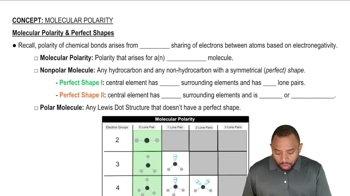
Polarity of Molecules
Polarity refers to the distribution of electrical charge over the atoms in a molecule. Polar molecules, like glucose, have regions of partial positive and negative charge due to differences in electronegativity between atoms. This property influences solubility, as polar substances tend to dissolve well in polar solvents like water, while nonpolar substances dissolve better in nonpolar solvents like hexane.
추천 영상:
가이드 코스
Molecular Polarity
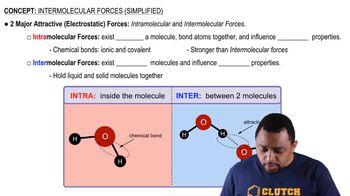
Intermolecular Forces
Intermolecular forces are the forces of attraction or repulsion between neighboring particles (atoms, molecules, or ions). In the case of glucose in water, hydrogen bonding is a significant intermolecular force, as glucose can form hydrogen bonds with water molecules. Understanding these forces helps predict solubility, as stronger interactions between solute and solvent lead to greater solubility.
추천 영상:
가이드 코스
Intermolecular vs Intramolecular Forces
Like Dissolves Like
The principle of 'like dissolves like' states that polar solvents dissolve polar solutes, and nonpolar solvents dissolve nonpolar solutes. This concept is crucial for predicting solubility; since glucose is a polar molecule, it is expected to be more soluble in water (a polar solvent) than in hexane (a nonpolar solvent). This principle helps in understanding the behavior of different compounds in various solvents.
추천 영상:
가이드 코스
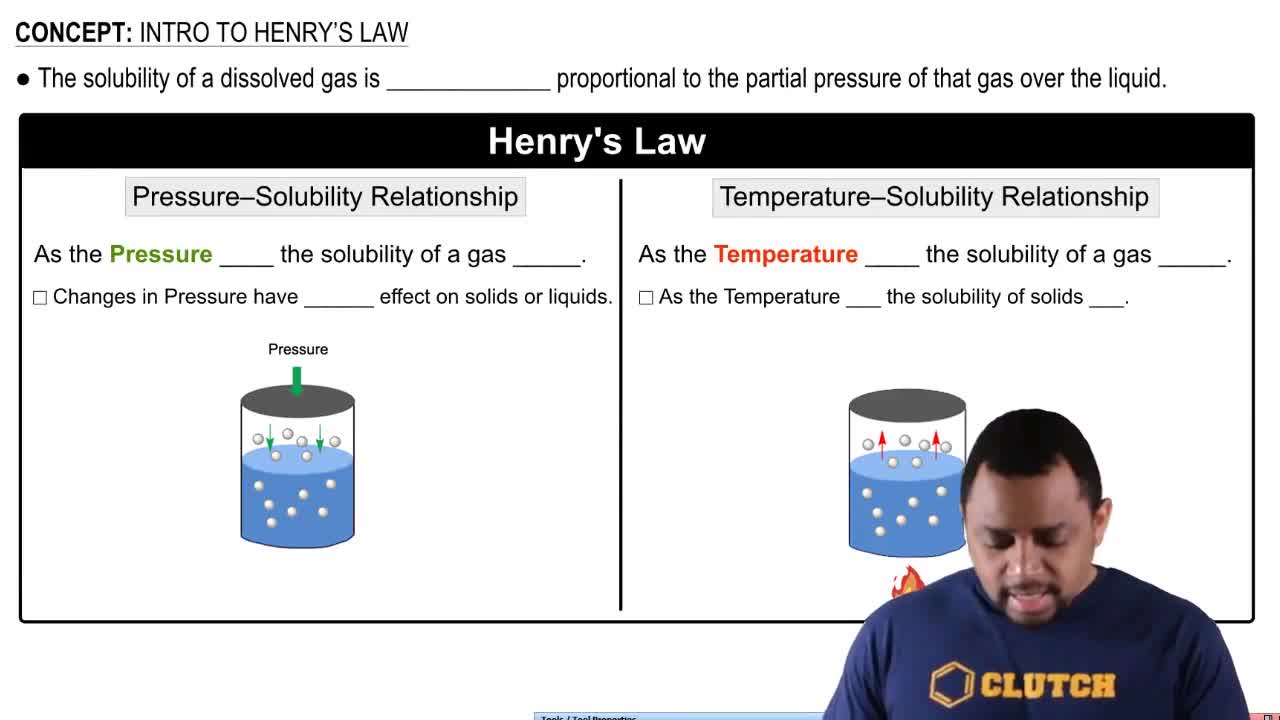
Henry's Law Solubility
관련 실천
교과서 질문
889
views
교과서 질문
For each compound, would you expect greater solubility in water or in hexane? Indicate the kinds of intermolecular forces that would occur between the solute and the solvent in which the molecule is most soluble. d. ethylene glycol
712
views
교과서 질문
When lithium iodide (LiI) is dissolved in water, the solution becomes hotter. b. What can you conclude about the relative magnitudes of the lattice energy of lithium iodide and its heat of hydration?
1504
views
교과서 질문
Which molecule would you expect to be more soluble in water: CH3CH2CH2OH or HOCH2CH2CH2OH?
3972
views
교과서 질문
Pick an appropriate solvent from Table 13.3 to dissolve each substance. State the kind of intermolecular forces that would occur between the solute and solvent in each case. b. sodium chloride (ionic)
867
views