The rate constant (k) for a reaction was measured as a function of temperature. A plot of ln k versus 1/T (in K) is linear and has a slope of -7012 K. Calculate the activation energy for the reaction.

Ch.15 - Chemical Kinetics

15장, 문제 71
The data shown here were collected for the first-order reaction: N2O(g) → N2(g) + O(g) Use an Arrhenius plot to determine the activation barrier and frequency factor for the reaction.
Temperature (K) Rate Constant (1 , s)
800 3.24⨉10- 5
900 0.00214
1000 0.0614
1100 0.955
검증된 단계별 안내1
First, understand that an Arrhenius plot graphs the natural logarithm of the rate constant (ln(k)) against the reciprocal of the temperature in Kelvin (1/T). This plot helps determine the activation energy and the frequency factor of a reaction.
Next, convert the given temperatures into their reciprocal form (1/T) where T is the temperature in Kelvin. This will be the x-axis of your Arrhenius plot.
Then, take the natural logarithm of each rate constant (ln(k)). These values will form the y-axis of your Arrhenius plot.
Plot the points with the reciprocal of the temperature on the x-axis and the natural logarithm of the rate constant on the y-axis. Draw the best fit line through these points.
Finally, the slope of the line from the Arrhenius plot will give you the negative activation energy divided by the gas constant (R), and the y-intercept will give you the natural logarithm of the frequency factor (ln(A)).

비슷한 문제에 대한 검증된 영상 답변:
이 영상 해법은 위 문제에 도움이 된다고 튜터들이 추천한 것입니다.
영상 길이:
3m주요 개념
질문에 올바르게 답하기 위해 반드시 이해해야 하는 핵심 개념들은 다음과 같습니다.
First-Order Reactions
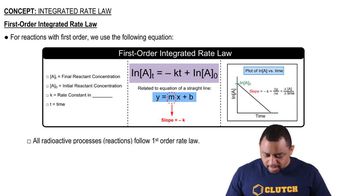
First-order reactions are chemical reactions where the rate is directly proportional to the concentration of one reactant. This means that if the concentration of the reactant doubles, the reaction rate also doubles. Understanding this concept is crucial for analyzing the provided rate constants at different temperatures, as it allows for the application of the integrated rate law to determine the relationship between concentration and time.
추천 영상:
가이드 코스
First-Order Reactions
Arrhenius Equation
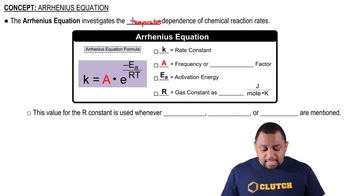
The Arrhenius equation describes how the rate constant of a reaction depends on temperature and activation energy. It is expressed as k = A * e^(-Ea/RT), where k is the rate constant, A is the frequency factor, Ea is the activation energy, R is the gas constant, and T is the temperature in Kelvin. This equation is fundamental for constructing an Arrhenius plot, which is a graph of ln(k) versus 1/T, allowing for the determination of both the activation energy and frequency factor from the slope and intercept.
추천 영상:
가이드 코스
Arrhenius Equation
Activation Energy
Activation energy (Ea) is the minimum energy required for a chemical reaction to occur. It represents the energy barrier that reactants must overcome to transform into products. In the context of the Arrhenius equation, a higher activation energy results in a lower rate constant at a given temperature, indicating that the reaction is slower. Understanding activation energy is essential for interpreting the results from the Arrhenius plot and assessing the feasibility of the reaction under different thermal conditions.
추천 영상:
가이드 코스
Activity Series Chart
관련 실천
교과서 질문
교과서 질문
The diagram shows the energy of a reaction as the reaction progresses. Label each blank box in the diagram.
a. reactants b. products c. activation energy (Ea) d. enthalpy of reaction (ΔHrxn)
2043
views
교과서 질문
The tabulated data show the rate constant of a reaction measured at several different temperatures. Use an Arrhenius plot to determine the activation barrier and frequency factor for the reaction.
Temperature (K) Rate Constant (1 , s)
300 0.0134
310 0.0407
320 0.114
330 0.303
340 0.757
2534
views
교과서 질문
The activation energy of a reaction is 44.2 kJ/mol and the frequency factor is 1.9⨉1011/ s. Calculate the rate constant of the reaction at 25 °C.
1
views