
Ch.15 - Chemical Kinetics
Tro - Chemistry: A Molecular Approach 6th Edition
Tro6th EditionChemistry: A Molecular ApproachISBN: 9780137832217당신이 사용하는 게 아니라요?교과서 변경
15장, 문제 107a

This reaction has an activation energy of zero in the gas phase: CH3 + CH3 → C2H6
a. Would you expect the rate of this reaction to change very much with temperature?

검증된 단계별 안내
1
Understand the concept of activation energy: Activation energy is the minimum energy required for a chemical reaction to occur. It acts as a barrier that reactants must overcome to transform into products.
Recognize the significance of zero activation energy: When a reaction has an activation energy of zero, it means that there is no energy barrier for the reaction to proceed. The reactants can convert to products without needing additional energy input.
Consider the effect of temperature on reaction rate: Generally, increasing the temperature increases the kinetic energy of molecules, leading to more frequent and energetic collisions, which typically increases the reaction rate.
Analyze the specific case of zero activation energy: Since the reaction has no energy barrier, the rate of reaction is not dependent on the energy distribution of molecules. Therefore, changes in temperature will have minimal effect on the rate of reaction.
Conclude the analysis: For this reaction with zero activation energy, the rate is expected to remain relatively constant with changes in temperature, as there is no energy barrier to influence the rate.

비슷한 문제에 대한 검증된 영상 답변:

이 영상 해법은 위 문제에 도움이 된다고 튜터들이 추천한 것입니다.
영상 길이:
2m

주요 개념

질문에 올바르게 답하기 위해 반드시 이해해야 하는 핵심 개념들은 다음과 같습니다.

Activation Energy

Activation energy is the minimum energy required for a chemical reaction to occur. In reactions with zero activation energy, the reactants can convert to products without needing to overcome an energy barrier, suggesting that the reaction can proceed readily under a variety of conditions.
추천 영상:
가이드 코스
02:02
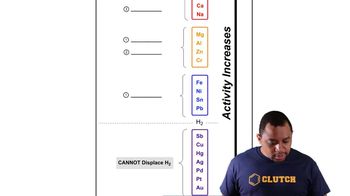
Activity Series Chart

Temperature and Reaction Rate

The rate of a chemical reaction typically increases with temperature due to the increased kinetic energy of the molecules, which leads to more frequent and effective collisions. However, in reactions with zero activation energy, the rate is less sensitive to temperature changes since the energy barrier is already negligible.
추천 영상:
가이드 코스
02:03
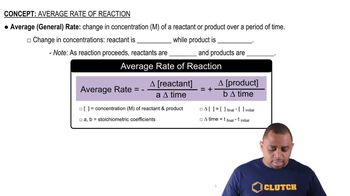
Average Rate of Reaction

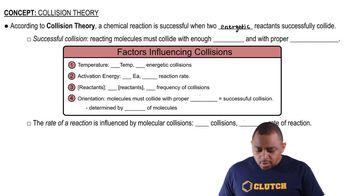
Collision Theory

Collision theory states that for a reaction to occur, reactant molecules must collide with sufficient energy and proper orientation. In the case of the given reaction, the lack of activation energy implies that even at lower temperatures, collisions can lead to product formation, resulting in a relatively constant reaction rate regardless of temperature fluctuations.
추천 영상:
가이드 코스
02:08
Collision Theory
관련 실천
교과서 질문

Anthropologists can estimate the age of a bone or other sample of organic matter by its carbon-14 content. The carbon-14 in a living organism is constant until the organism dies, after which carbon- 14 decays with first-order kinetics and a half-life of 5730 years. Suppose a bone from an ancient human contains 19.5% of the C-14 found in living organisms. How old is the bone?

2725
views
교과서 질문

The kinetics of this reaction were studied as a function of temperature. (The reaction is first order in each reactant and second order overall.)

C2H5Br(aq) + OH- (aq) → C2H5OH(l) + Br- (aq)

Temperature (°C) k (L,mol •s)

25 8.81⨉10-5

35 0.000285

45 0.000854

55 0.00239

65 0.00633

b. Determine the rate constant at 15 °C.

1072
views
교과서 질문

Consider the two reactions:

O + N2 → NO + N Ea = 315 kJ/mol

Cl + H2 → HCl + H Ea = 23 kJ/mol

a. Why is the activation barrier for the first reaction so much higher than that for the second?

561
views
교과서 질문

The evaporation of a 120-nm film of n-pentane from a single crystal of aluminum oxide is zero order with a rate constant of 1.92⨉1013 molecules/cm2•s at 120 K. a. If the initial surface coverage is 8.9⨉1016 molecules/cm2, how long will it take for one-half of the film to evaporate?

881
views
1
rank
교과서 질문

Consider the two reactions:

O + N2 → NO + N Ea = 315 kJ/mol

Cl + H2 → HCl + H Ea = 23 kJ/mol

b. The frequency factors for these two reactions are very close to each other in value. Assuming that they are the same, calculate the ratio of the reaction rate constants for these two reactions at 25 °C.

689
views
교과서 질문

The reaction 2 N2O5 → 2 N2O4 + O2 takes place at around room temperature in solvents such as CCl4. The rate constant at 293 K is found to be 2.35⨉10-4 s-1, and at 303 K the rate constant is found to be 9.15⨉10-4 s-1. Calculate the frequency factor for the reaction.

1231
views