

Ch.16 - Chemical Equilibrium
Tro - Chemistry: A Molecular Approach 6th Edition
Tro6th EditionChemistry: A Molecular ApproachISBN: 9780137832217당신이 사용하는 게 아니라요?교과서 변경
16장, 문제 54

Consider the reaction and the associated equilibrium constant: aA(g) + bB(g) ⇌ cC(g) with Kc = 5.0. Find the equilibrium concentrations of A, B, and C for the given values of a, b, and c. Assume that the initial concentrations of A and B are each 1.0 M and that no product is present at the beginning of the reaction. Calculate the equations for x without solving them for the following cases: a) a=1, b=1, c=2; b) a=1, b=1, c=1; c) a=2, b=1, c=1.

검증된 단계별 안내
1
Identify the balanced chemical equation for each case and write the expression for the equilibrium constant Kc.
Set up an ICE (Initial, Change, Equilibrium) table for each case to track the changes in concentrations of A, B, and C.
Express the equilibrium concentrations in terms of the change variable x, where x is the amount of A and B that reacts.
Substitute the equilibrium concentrations into the Kc expression for each case.
Solve the resulting equation for x, but do not calculate the final value.

주요 개념

질문에 올바르게 답하기 위해 반드시 이해해야 하는 핵심 개념들은 다음과 같습니다.

Equilibrium Constant (Kc)

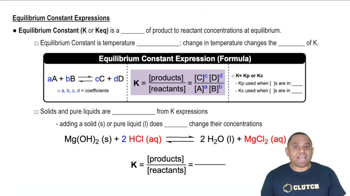
The equilibrium constant (Kc) is a numerical value that expresses the ratio of the concentrations of products to reactants at equilibrium for a given reaction at a specific temperature. It is calculated using the formula Kc = [C]^c / ([A]^a * [B]^b), where [A], [B], and [C] are the molar concentrations of the reactants and products. A Kc value greater than 1 indicates that products are favored at equilibrium, while a value less than 1 suggests that reactants are favored.
추천 영상:
가이드 코스
03:20
Equilibrium Constant Expressions

ICE Table

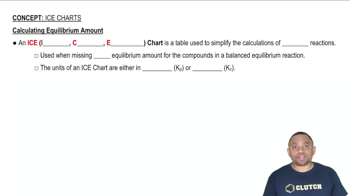
An ICE table (Initial, Change, Equilibrium) is a tool used to organize the concentrations of reactants and products in a chemical reaction at different stages. It helps in determining the changes in concentration as the reaction progresses towards equilibrium. By filling in the initial concentrations, the changes that occur as the reaction shifts, and the equilibrium concentrations, one can derive expressions for the unknowns in the reaction.
추천 영상:
가이드 코스
01:14
ICE Charts and Equilibrium Amount

Stoichiometry

Stoichiometry involves the quantitative relationships between the amounts of reactants and products in a chemical reaction, based on the balanced chemical equation. It allows for the calculation of how much of each substance is consumed or produced during the reaction. Understanding stoichiometry is essential for setting up the equations for equilibrium concentrations, as it dictates the proportions in which reactants and products interact.
추천 영상:
가이드 코스
01:16
Stoichiometry Concept