Consider the reaction: SO2Cl2(g) ⇌ SO2(g) + Cl2(g) Kp = 2.91*10^3 at 298 K In a reaction at equilibrium, the partial pressure of SO2 is 117 torr and that of Cl2 is 205 torr. What is the partial pressure of SO2Cl2 in this mixture?

Ch.16 - Chemical Equilibrium

16장, 문제 39
Consider the reaction: N2(g) + 3 H2(g) ⇌ 2 NH3(g) Complete the table. Assume that all concentrations are equilibrium concentrations in M.
T (K) [N2] [H2] [NH3] Kc
500 0.115 0.105 0.439 _
575 0.110 _ 0.128 9.6
775 0.120 0.140 _ 0.0584
검증된 단계별 안내1
Identify the balanced chemical equation for the reaction: \( N_2(g) + 3H_2(g) \rightleftharpoons 2NH_3(g) \).
Use the equilibrium constant expression for the reaction: \( K_c = \frac{[NH_3]^2}{[N_2][H_2]^3} \).
For the first row (T = 500 K), plug the given concentrations into the equilibrium expression to verify the provided \( K_c \) value.
For the second row (T = 575 K), use the given \([N_2]\), \([NH_3]\), and the calculated \( K_c \) from the first row to solve for the missing \([H_2]\) concentration.
For the third row (T = 775 K), use the given \([N_2]\), \([H_2]\), and the calculated \( K_c \) from the first row to solve for the missing \([NH_3]\) concentration.

비슷한 문제에 대한 검증된 영상 답변:
이 영상 해법은 위 문제에 도움이 된다고 튜터들이 추천한 것입니다.
영상 길이:
1m주요 개념
질문에 올바르게 답하기 위해 반드시 이해해야 하는 핵심 개념들은 다음과 같습니다.
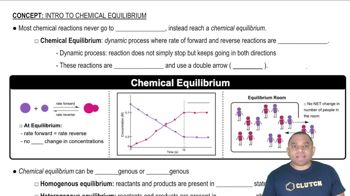
Chemical Equilibrium
Chemical equilibrium occurs when the rates of the forward and reverse reactions are equal, resulting in constant concentrations of reactants and products. In this state, the system is dynamic, meaning that reactions continue to occur, but there is no net change in concentration. Understanding this concept is crucial for analyzing equilibrium constants and predicting how changes in conditions affect the system.
추천 영상:
가이드 코스
Chemical Equilibrium Concepts
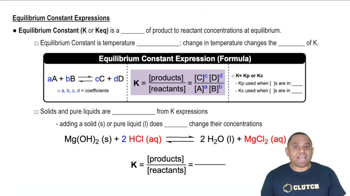
Equilibrium Constant (Kc)
The equilibrium constant (Kc) is a numerical value that expresses the ratio of the concentrations of products to reactants at equilibrium, each raised to the power of their coefficients in the balanced equation. It provides insight into the position of equilibrium; a larger Kc indicates a greater concentration of products, while a smaller Kc suggests more reactants. Calculating Kc is essential for completing the provided table.
추천 영상:
가이드 코스
Equilibrium Constant Expressions
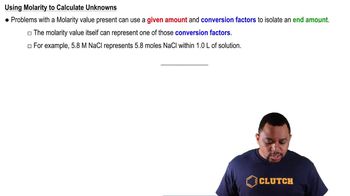
Concentration Units (Molarity)
Molarity (M) is a unit of concentration defined as the number of moles of solute per liter of solution. It is commonly used in chemical equations and equilibrium expressions to quantify the amounts of reactants and products. Understanding how to convert between moles and molarity is vital for accurately filling in the missing values in the equilibrium concentration table.
추천 영상:
가이드 코스
Molarity
관련 실천
교과서 질문
교과서 질문
Calculate Kp for each reaction. b. CH4(g) + H2O(g) ⇌ CO(g) + 3 H2(g) Kc = 1.3×10^22 (at 298 K)
교과서 질문
Consider the following reaction: H2(g) + I2(g) ⇌ 2 HI(g) Complete the table. Assume that all concentrations are equilibrium concentrations in M.
T (°C) [H2] [I2] [HI] Kc
25 0.0355 0.0388 0.922 _
340 _ 0.0455 0.387 9.6
445 0.0485 0.0468 _ 50.2
1347
views
교과서 질문
Consider the reaction:
2 NO( g) + Br2( g)Δ2 NOBr( g) Kp = 28.4 at 298 K
In a reaction mixture at equilibrium, the partial pressure of NO is 125 torr and that of Br2 is 148 torr. What is the partial pressure of NOBr in this mixture?