Consider this reaction at equilibrium: 2 BrNO(g) ⇌ 2 NO(g) + Br2(g) Predict whether the reaction will shift left, shift right, or remain unchanged after each disturbance. b. BrNO is added to the reaction mixture.
Ch.16 - Chemical Equilibrium

16장, 문제 68a
Consider this reaction at equilibrium: 2 BrNO(g) ⇌ 2 NO(g) + Br2(g) Predict whether the reaction will shift left, shift right, or remain unchanged after each disturbance. a. NO is added to the reaction mixture.
검증된 단계별 안내1
Identify the reaction and the change applied: The reaction given is 2 BrNO(g) ⇌ 2 NO(g) + Br2(g), and the disturbance is the addition of NO(g) to the reaction mixture.
Recall Le Chatelier's Principle, which states that if a system at equilibrium is disturbed, it will adjust itself to counteract the disturbance and restore a new equilibrium.
Analyze the effect of adding NO(g): Adding more NO(g) increases the concentration of NO(g) on the right side of the equation.
Predict the shift due to the disturbance: According to Le Chatelier's Principle, increasing the concentration of a product (NO(g)) will shift the equilibrium to the left to reduce the concentration of NO(g) by converting it back to BrNO(g).
Conclude the direction of the shift: The reaction will shift to the left in response to the addition of NO(g).

비슷한 문제에 대한 검증된 영상 답변:
이 영상 해법은 위 문제에 도움이 된다고 튜터들이 추천한 것입니다.
영상 길이:
1m도움이 되었나요?
주요 개념
질문에 올바르게 답하기 위해 반드시 이해해야 하는 핵심 개념들은 다음과 같습니다.
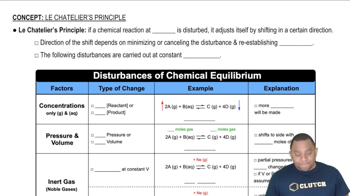
Le Chatelier's Principle
Le Chatelier's Principle states that if a dynamic equilibrium is disturbed by changing the conditions, the system will adjust to counteract the change and restore a new equilibrium. This principle helps predict the direction of the shift in equilibrium when a reactant or product concentration is altered.
추천 영상:
가이드 코스
Le Chatelier's Principle
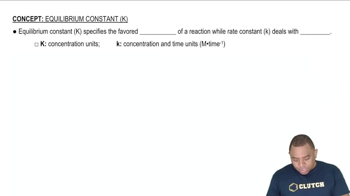
Equilibrium Constant (K)
The equilibrium constant (K) is a numerical value that expresses the ratio of the concentrations of products to reactants at equilibrium for a given reaction at a specific temperature. Changes in concentration, pressure, or temperature can affect the value of K, influencing the position of equilibrium.
추천 영상:
가이드 코스
Equilibrium Constant K
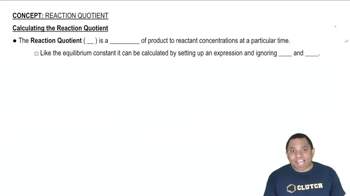
Reaction Quotient (Q)
The reaction quotient (Q) is a measure of the relative concentrations of products and reactants at any point in time, not just at equilibrium. By comparing Q to K, one can determine the direction in which the reaction will shift to reach equilibrium: if Q < K, the reaction shifts right; if Q > K, it shifts left.
추천 영상:
가이드 코스
Reaction Quotient Q
관련 실천
교과서 질문
773
views
교과서 질문
Consider this reaction at equilibrium: 2 BrNO(g) ⇌ 2 NO(g) + Br2(g) Predict whether the reaction will shift left, shift right, or remain unchanged after each disturbance. c. Br2 is removed from the reaction mixture.
1924
views
교과서 질문
Consider the reaction: A(g) ⇌ B(g) + C(g) Find the equilibrium concentrations of A, B, and C for each value of Kc. Assume that the initial concentration of A in each case is 1.0 M and that the reaction mixture initially contains no products. Make any appropriate simplifying assumptions. b. Kc = 0.010
4059
views
1
rank
교과서 질문
Consider this reaction at equilibrium:
C(s) + H2O(g) ⇌ CO(g) + H2(g)
Predict whether the reaction will shift left, shift right, or remain unchanged after each disturbance.
a. C is removed from the reaction mixture.