

Ch.16 - Chemical Equilibrium
Tro - Chemistry: A Molecular Approach 6th Edition
Tro6th EditionChemistry: A Molecular ApproachISBN: 9780137832217당신이 사용하는 게 아니라요?교과서 변경
16장, 문제 29b

This reaction has an equilibrium constant of Kp = 2.26⨉104 at 298 K. CO(g) + 2 H2(g) ⇌ CH3OH(g) Calculate Kp for each reaction and predict whether reactants or products will be favored at equilibrium.
b. 1/2 CO(g) + H2 (g) ⇌ 1/2 CH3OH(g)

검증된 단계별 안내
1
Step 1: Understand the relationship between the original reaction and the new reaction. In this case, the new reaction is the original reaction divided by 2.
Step 2: Use the rule that if a reaction is divided by a factor, the equilibrium constant for the new reaction is the square root of the original equilibrium constant. This is because the equilibrium constant is a ratio of the concentrations of the products to the reactants, each raised to the power of their stoichiometric coefficients. When the coefficients are halved, the powers in the ratio are also halved, which is equivalent to taking the square root.
Step 3: Calculate the new equilibrium constant, Kp', by taking the square root of the original Kp. The square root of 2.26⨉104 will give you Kp' for the new reaction.
Step 4: Determine whether the reactants or products are favored at equilibrium. If Kp' is greater than 1, the products are favored. If Kp' is less than 1, the reactants are favored.
Step 5: Compare the calculated Kp' with 1 to determine whether the reactants or products are favored at equilibrium.

비슷한 문제에 대한 검증된 영상 답변:

이 영상 해법은 위 문제에 도움이 된다고 튜터들이 추천한 것입니다.
영상 길이:
47s

주요 개념

질문에 올바르게 답하기 위해 반드시 이해해야 하는 핵심 개념들은 다음과 같습니다.

Equilibrium Constant (Kp)

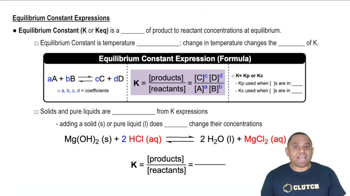
The equilibrium constant, Kp, quantifies the ratio of the concentrations of products to reactants at equilibrium for a given reaction at a specific temperature. It is expressed in terms of partial pressures for gaseous reactions. A larger Kp value indicates that products are favored at equilibrium, while a smaller Kp suggests that reactants are favored.
추천 영상:
가이드 코스
03:20
Equilibrium Constant Expressions

Reaction Stoichiometry

Reaction stoichiometry refers to the quantitative relationship between reactants and products in a chemical reaction, as represented by the balanced equation. It is essential for calculating the equilibrium constant for reactions with different stoichiometric coefficients, as changes in coefficients affect the equilibrium expression and the value of Kp.
추천 영상:
가이드 코스
01:16
Stoichiometry Concept

Le Chatelier's Principle

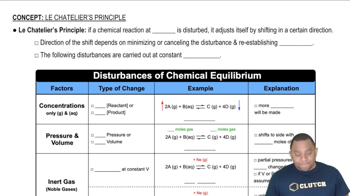
Le Chatelier's Principle states that if a dynamic equilibrium is disturbed by changing the conditions (such as concentration, pressure, or temperature), the system will adjust to counteract the change and restore a new equilibrium. This principle helps predict the direction in which the reaction will shift when the equilibrium is altered, indicating whether reactants or products will be favored.
추천 영상:
가이드 코스
07:32
Le Chatelier's Principle
관련 실천
교과서 질문

This reaction has an equilibrium constant of Kp = 2.2⨉106 at 298 K. 2 COF2(g) ⇌ CO2(g) + CF4(g) Calculate Kp for each reaction and predict whether reactants or products will be favored at equilibrium.

b. 6 COF2(g) ⇌ 3 CO2(g) + 3 CF4(g)

713
views
교과서 질문

This reaction has an equilibrium constant of Kp = 2.26⨉104 at 298 K. CO(g) + 2 H2(g) ⇌ CH3OH(g) Calculate Kp for each reaction and predict whether reactants or products will be favored at equilibrium. a. CH3OH(g) ⇌ CO(g) + 2 H2(g)

790
views
교과서 질문

This reaction has an equilibrium constant of Kp = 2.2⨉106 at 298 K. 2 COF2(g) ⇌ CO2(g) + CF4(g) Calculate Kp for each reaction and predict whether reactants or products will be favored at equilibrium.

a. COF2 (g) ⇌ 1/2 CO2(g) + 1/2 CF4(g)

2676
views
1
comments
교과서 질문

This reaction has an equilibrium constant of Kp = 2.26⨉104 at 298 K. CO(g) + 2 H2(g) ⇌ CH3OH(g) Calculate Kp for each reaction and predict whether reactants or products will be favored at equilibrium.

c. 2 CH3OH(g) ⇌ 2 CO(g) + 4 H2(g)

726
views
교과서 질문

H2 and I2 are combined in a flask and allowed to react according to the reaction: H2(g) + I2(g) ⇌ 2 HI(g) Examine the figures (sequential in time) and answer the questions: a. Which figure represents the point at which equilibrium is reached?

824
views
교과서 질문

A chemist trying to synthesize a particular compound attempts two different synthesis reactions. The equilibrium constants for the two reactions are 23.3 and 2.2⨉104 at room temperature. However, upon carrying out both reactions for 15 minutes, the chemist finds that the reaction with the smaller equilibrium constant produces more of the desired product. Explain how this might be possible.

1175
views