
Ch.16 - Chemical Equilibrium
Tro - Chemistry: A Molecular Approach 6th Edition
Tro6th EditionChemistry: A Molecular ApproachISBN: 9780137832217당신이 사용하는 게 아니라요?교과서 변경
16장, 문제 73

This reaction is endothermic. C(s) + CO2(g) ⇌ 2 CO(g) Predict the effect (shift right, shift left, or no effect) of increasing and decreasing the reaction temperature. How does the value of the equilibrium constant depend on temperature?

검증된 단계별 안내
1
Identify the type of reaction: The given reaction is endothermic, which means it absorbs heat. In the reaction equation, C(s) + CO2(g) ⇌ 2 CO(g), heat can be considered as a reactant.
Apply Le Chatelier's Principle: According to Le Chatelier's Principle, if a system at equilibrium is subjected to a change, the system will adjust itself to counteract that change and restore a new equilibrium.
Predict the effect of increasing temperature: Since the reaction is endothermic, increasing the temperature adds more heat to the system. This is akin to increasing the concentration of a reactant in a chemical reaction. Therefore, the system will shift to the right to consume the added heat, favoring the formation of more products (CO(g)).
Predict the effect of decreasing temperature: Decreasing the temperature removes heat from the system, similar to decreasing the concentration of a reactant. Thus, the system will shift to the left, favoring the formation of more reactants (C(s) and CO2(g)).
Understand the effect on the equilibrium constant (K): The equilibrium constant, K, for an endothermic reaction increases with an increase in temperature and decreases with a decrease in temperature. This is because K is directly related to the extent of product formation, which is favored by an increase in temperature in endothermic reactions.

비슷한 문제에 대한 검증된 영상 답변:

이 영상 해법은 위 문제에 도움이 된다고 튜터들이 추천한 것입니다.
영상 길이:
4m
도움이 되었나요?

주요 개념

질문에 올바르게 답하기 위해 반드시 이해해야 하는 핵심 개념들은 다음과 같습니다.

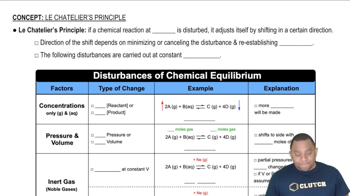
Le Chatelier's Principle

Le Chatelier's Principle states that if a dynamic equilibrium is disturbed by changing the conditions, the system will adjust to counteract the change and restore a new equilibrium. In the context of temperature changes, increasing the temperature of an endothermic reaction will shift the equilibrium to the right, favoring the formation of products, while decreasing the temperature will shift it to the left, favoring the reactants.
추천 영상:
가이드 코스
07:32
Le Chatelier's Principle

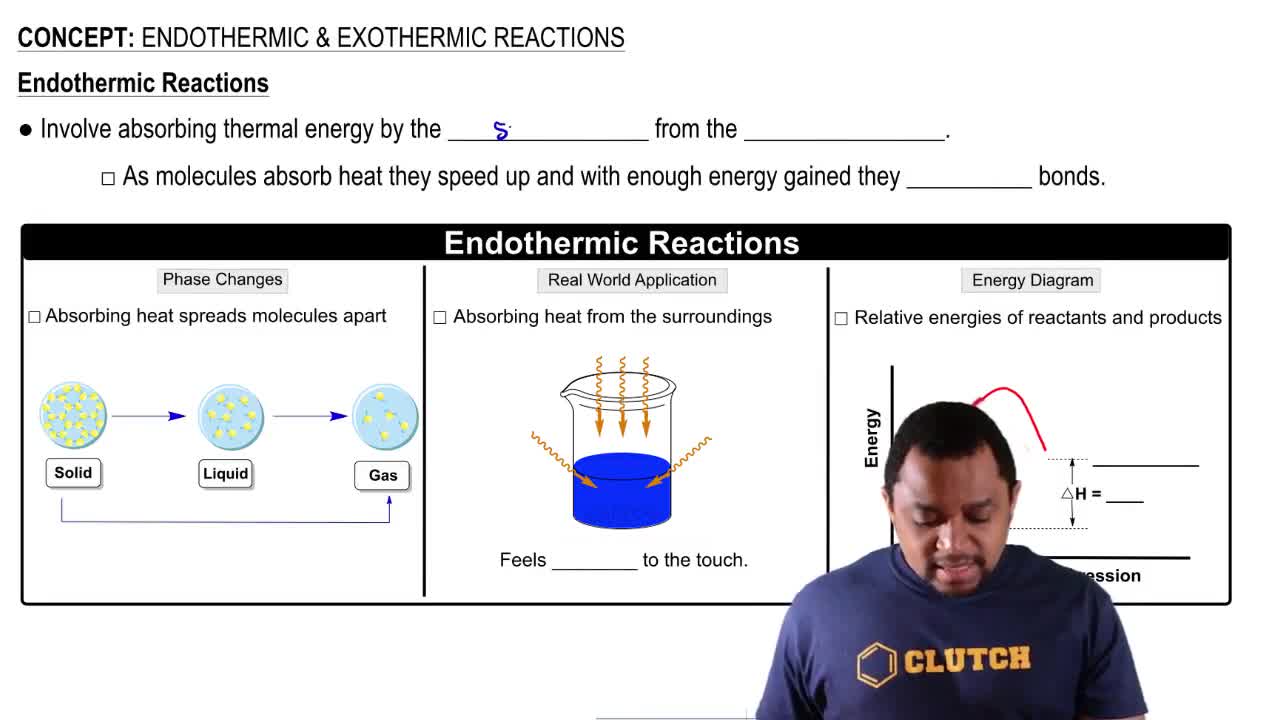
Endothermic Reactions

Endothermic reactions absorb heat from their surroundings, resulting in a decrease in temperature of the environment. In the given reaction, the conversion of solid carbon and carbon dioxide gas into carbon monoxide gas requires heat input, which is why increasing the temperature will favor the production of CO, while decreasing it will hinder the reaction.
추천 영상:
가이드 코스
02:30
Endothermic & Exothermic Reactions

Equilibrium Constant (K)

The equilibrium constant (K) quantifies the ratio of the concentrations of products to reactants at equilibrium for a given reaction at a specific temperature. For endothermic reactions, increasing the temperature generally increases the value of K, indicating a greater concentration of products at equilibrium, while decreasing the temperature typically lowers K, favoring reactants.
추천 영상:
가이드 코스
01:14
Equilibrium Constant K
관련 실천
교과서 질문

Each reaction is allowed to come to equilibrium, and then the volume is changed as indicated. Predict the effect (shift right, shift left, or no effect) of the indicated volume change. a. CO(g) + H2O( g) ⇌ CO2(g) + H2(g) (volume is decreased)

456
views
교과서 질문

Coal, which is primarily carbon, can be converted to natural gas, primarily CH4, by the exothermic reaction: C(s) + 2 H2(g) ⇌ CH4(g) Which disturbance will favor CH4 at equilibrium?

a. adding more C to the reaction mixture b. adding more H2 to the reaction mixture d. lowering the volume of the reaction mixture f. adding neon gas to the reaction mixture

869
views
교과서 질문

Each reaction is allowed to come to equilibrium, and then the volume is changed as indicated. Predict the effect (shift right, shift left, or no effect) of the indicated volume change. b. PCl3(g) + Cl2(g) ⇌ PCl5(g) (volume is increased)

373
views
교과서 질문

Coal, which is primarily carbon, can be converted to natural gas, primarily CH4, by the exothermic reaction: C(s) + 2 H2(g) ⇌ CH4(g) Which disturbance will favor CH4 at equilibrium? c. raising the temperature of the reaction mixture

1688
views
교과서 질문

Each reaction is allowed to come to equilibrium, and then the volume is changed as indicated. Predict the effect (shift right, shift left, or no effect) of the indicated volume change. c. CaCO3(s) ⇌ CaO(s) + CO2(g) (volume is increased)

657
views
교과서 질문

Coal, which is primarily carbon, can be converted to natural gas, primarily CH4, by the exothermic reaction: C(s) + 2 H2(g) ⇌ CH4(g) Which disturbance will favor CH4 at equilibrium? e. adding a catalyst to the reaction mixture

450
views