

Ch.17 - Acids and Bases
Tro - Chemistry: A Molecular Approach 6th Edition
Tro6th EditionChemistry: A Molecular ApproachISBN: 9780137832217당신이 사용하는 게 아니라요?교과서 변경
17장, 문제 131c

Based on these molecular views, determine whether each pictured acid is weak or strong.
Molecular view of formic acid in water, showing HCOOH, HCOO-, and H3O+ ions.

검증된 단계별 안내
1
Identify the species present in the solution: HCOOH (formic acid), HCOO- (formate ion), and H3O+ (hydronium ion).
Understand that a strong acid completely dissociates in water, while a weak acid only partially dissociates.
Observe the molecular view: there are both HCOOH molecules and HCOO- ions present, indicating that not all HCOOH has dissociated.
Note the presence of H3O+ ions, which are produced when an acid donates a proton to water.
Conclude that since both the undissociated form (HCOOH) and the dissociated form (HCOO-) are present, formic acid is a weak acid.

비슷한 문제에 대한 검증된 영상 답변:

이 영상 해법은 위 문제에 도움이 된다고 튜터들이 추천한 것입니다.
영상 길이:
1m
도움이 되었나요?

주요 개념

질문에 올바르게 답하기 위해 반드시 이해해야 하는 핵심 개념들은 다음과 같습니다.

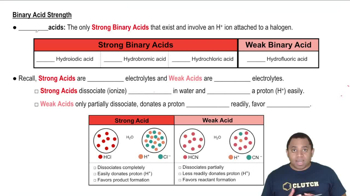
Acid Strength

Acid strength refers to the ability of an acid to donate protons (H+) in a solution. Strong acids completely dissociate in water, releasing all their protons, while weak acids only partially dissociate. This distinction is crucial for understanding the behavior of acids in chemical reactions and their impact on pH levels.
추천 영상:
가이드 코스
03:51
Binary Acid Strengths

Dissociation Equilibrium

Dissociation equilibrium describes the balance between the undissociated acid and its ions in solution. For weak acids, this equilibrium lies to the left, meaning that only a fraction of the acid molecules dissociate into ions. The presence of both the undissociated acid and its ions, as shown in the image, indicates that formic acid is a weak acid.
추천 영상:
가이드 코스
02:35
Thermal Equilibrium

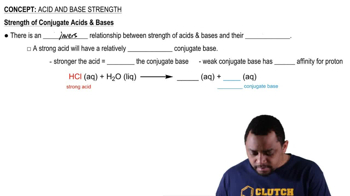
Conjugate Base

The conjugate base of an acid is the species that remains after the acid donates a proton. In the case of formic acid (HCOOH), its conjugate base is the formate ion (HCOO-). Understanding the relationship between an acid and its conjugate base is essential for predicting the behavior of acids in solution and their relative strengths.
추천 영상:
가이드 코스
00:50
Strength of Conjugate Acids and Bases
관련 실천
교과서 질문

The binding of oxygen by hemoglobin in the blood involves the equilibrium reaction: HbH+(aq) + O2(aq) ⇌ HbO2(aq) + H+(aq) In this equation, Hb is hemoglobin. The pH of normal human blood is highly controlled within a range of 7.35 to 7.45. Given the above equilibrium, why is this important? What would happen to the oxygen-carrying capacity of hemoglobin if blood became too acidic (a dangerous condition known as acidosis)?

10065
views
1
rank
교과서 질문

Based on these molecular views, determine whether each pictured acid is weak or strong.

교과서 질문

Identify the Lewis acid and Lewis base from among the reactants in each equation. b. AlBr3 + NH3 ⇌ H3NAlBr3 c. F(aq) + BF3(aq) ⇌ BF4(aq)

442
views
교과서 질문

Carbon dioxide dissolves in water according to the equations:

CO2(g) + H2O(l) ⇌ H2CO3(aq)

H2CO3(aq) + H2O(l) ⇌ HCO3(aq) + H3O+(aq)

Carbon dioxide levels in the atmosphere have increased about 20% over the last century. Given that Earth's oceans are exposed to atmospheric carbon dioxide, what effect might the increased CO2 be having on the pH of the world's oceans? What effect might this change be having on the limestone structures (primarily CaCO3) of coral reefs and marine shells?

8650
views
교과서 질문

Identify the Lewis acid and Lewis base from among the reactants in each equation. a. Ag+(aq) + 2 NH3(aq) ⇌ Ag(NH3)2+(aq)

1113
views
교과서 질문

Identify the Lewis acid and Lewis base from among the reactants in each equation. a. Fe3+(aq) + 6 H2O(l) ⇌ Fe(H2O)63+(aq) b. Zn2+(aq) + 4 NH3(aq) ⇌ Zn(NH3)42+(aq) c. (CH3)3N(g) + BF3(g) ⇌ (CH3)3NBF3(s)

1253
views