Determine whether or not the mixing of each pair of solutions results in a buffer. b.155.0 mL of 0.15 M NH3 ; 155.0 mL of 0.10 M HCl

Ch.18 - Aqueous Ionic Equilibrium

18장, 문제 57a
Blood is buffered by carbonic acid and the bicarbonate ion. Normal blood plasma is 0.024 M in HCO3- and 0.0012 M H2CO3 (pKa1 for H2CO3 at body temperature is 6.1).
a. What is the pH of blood plasma?
검증된 단계별 안내1
Identify the components of the buffer system: carbonic acid (H_2CO_3) and bicarbonate ion (HCO_3^-).
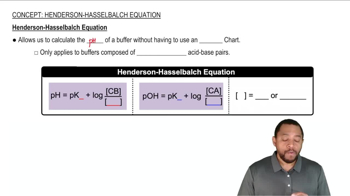
Use the Henderson-Hasselbalch equation for buffer solutions: \( \text{pH} = \text{pK}_a + \log \left( \frac{[\text{A}^-]}{[\text{HA}]} \right) \), where \([\text{A}^-]\) is the concentration of the base (HCO_3^-) and \([\text{HA}]\) is the concentration of the acid (H_2CO_3).
Substitute the given concentrations into the equation: \([\text{A}^-] = 0.024 \text{ M}\) and \([\text{HA}] = 0.0012 \text{ M}\).
Substitute the given \(\text{pK}_a\) value into the equation: \(\text{pK}_a = 6.1\).
Calculate the pH using the equation: \( \text{pH} = 6.1 + \log \left( \frac{0.024}{0.0012} \right) \).

비슷한 문제에 대한 검증된 영상 답변:
이 영상 해법은 위 문제에 도움이 된다고 튜터들이 추천한 것입니다.
영상 길이:
4m도움이 되었나요?
주요 개념
질문에 올바르게 답하기 위해 반드시 이해해야 하는 핵심 개념들은 다음과 같습니다.
Buffer Systems
Buffer systems are solutions that resist changes in pH upon the addition of small amounts of acid or base. In biological systems, buffers maintain the pH within a narrow range, which is crucial for proper physiological function. The bicarbonate buffer system, involving carbonic acid (H2CO3) and bicarbonate ion (HCO3-), is particularly important in regulating blood pH.
추천 영상:
가이드 코스
Buffer Capacity
Henderson-Hasselbalch Equation
The Henderson-Hasselbalch equation relates the pH of a buffer solution to the concentration of its acidic and basic components. It is expressed as pH = pKa + log([A-]/[HA]), where [A-] is the concentration of the base (bicarbonate) and [HA] is the concentration of the acid (carbonic acid). This equation is essential for calculating the pH of buffered solutions, such as blood plasma.
추천 영상:
가이드 코스
Henderson-Hasselbalch Equation
pKa and Acid-Base Equilibrium
pKa is the negative logarithm of the acid dissociation constant (Ka) and indicates the strength of an acid in solution. A lower pKa value signifies a stronger acid that dissociates more readily. In the context of the bicarbonate buffer system, the pKa of carbonic acid (6.1) helps determine the pH of blood plasma by indicating the equilibrium between carbonic acid and bicarbonate ions.
추천 영상:
가이드 코스
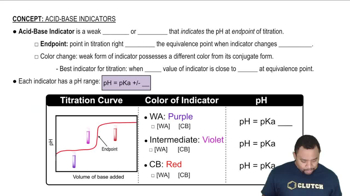
Acid-Base Indicators
관련 실천
교과서 질문
교과서 질문
The fluids within cells are buffered by H2PO4- and HPO42- . b. Could a buffer system employing H3PO4 as the weak acid and H2PO4- as the weak base be used as a buffer system within cells? Explain.
1549
views
1
rank
교과서 질문
Blood is buffered by carbonic acid and the bicarbonate ion. Normal blood plasma is 0.024 M in HCO3- and 0.0012 M H2CO3 (pKa1 for H2CO3 at body temperature is 6.1).
c. Given the volume from part (b), what mass of NaOH can be neutralized before the pH rises above 7.8?
566
views
교과서 질문
Determine whether or not the mixing of each pair of solutions results in a buffer. d. 150.0 mL of 0.15 M HCl; 135.0 mL of 0.25 M NaOH
교과서 질문
Determine whether or not the mixing of each pair of solutions results in a buffer. c. 225.0 mL of 0.10 M NH3 ; 250.0 mL of 0.15 M NH4Cl