Ch.18 - Aqueous Ionic Equilibrium
Tro - Chemistry: A Molecular Approach 6th Edition
Tro6th EditionChemistry: A Molecular ApproachISBN: 9780137832217당신이 사용하는 게 아니라요?교과서 변경
18장, 문제 37

Use the Henderson–Hasselbalch equation to calculate the pH of each solution in Problem 29.

검증된 단계별 안내
1
Identify the components of the buffer solution from Problem 29, which typically includes a weak acid and its conjugate base.
Write down the Henderson–Hasselbalch equation: \( \text{pH} = \text{pK}_a + \log \left( \frac{[\text{A}^-]}{[\text{HA}]} \right) \), where \([\text{A}^-]\) is the concentration of the conjugate base and \([\text{HA}]\) is the concentration of the weak acid.
Determine the \(\text{pK}_a\) of the weak acid from a table of acid dissociation constants or from the problem statement.
Substitute the concentrations of the conjugate base \([\text{A}^-]\) and the weak acid \([\text{HA}]\) into the Henderson–Hasselbalch equation.
Calculate the logarithmic term and add it to the \(\text{pK}_a\) to find the pH of the solution.

비슷한 문제에 대한 검증된 영상 답변:

이 영상 해법은 위 문제에 도움이 된다고 튜터들이 추천한 것입니다.
영상 길이:
3m
도움이 되었나요?

주요 개념

질문에 올바르게 답하기 위해 반드시 이해해야 하는 핵심 개념들은 다음과 같습니다.

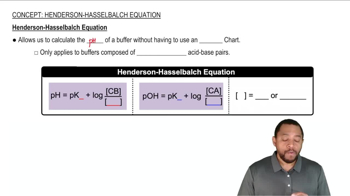
Henderson-Hasselbalch Equation

The Henderson-Hasselbalch equation is a mathematical formula used to calculate the pH of a buffer solution. It relates the pH of the solution to the pKa of the acid and the ratio of the concentrations of the conjugate base to the acid. The equation is expressed as pH = pKa + log([A-]/[HA]), where [A-] is the concentration of the base and [HA] is the concentration of the acid.
추천 영상:
가이드 코스
02:40
Henderson-Hasselbalch Equation

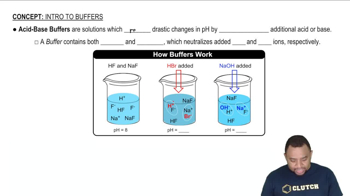
Buffer Solutions

Buffer solutions are mixtures that can resist changes in pH upon the addition of small amounts of acids or bases. They typically consist of a weak acid and its conjugate base or a weak base and its conjugate acid. Understanding how buffers work is essential for applying the Henderson-Hasselbalch equation, as it helps predict how the pH will change in response to different concentrations of the acid and base.
추천 영상:
가이드 코스
03:02
Buffer Solutions

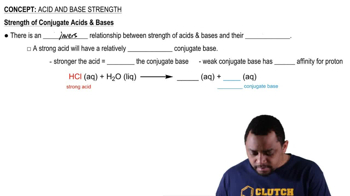
pKa and Acid-Base Strength

The pKa is a measure of the strength of an acid in solution; it is the negative logarithm of the acid dissociation constant (Ka). A lower pKa value indicates a stronger acid, which dissociates more completely in solution. Knowing the pKa of the acid involved in the buffer system is crucial for using the Henderson-Hasselbalch equation effectively, as it directly influences the calculated pH.
추천 영상:
가이드 코스
00:50
Strength of Conjugate Acids and Bases