Consider this reaction occurring at 298 K: N2O(g) + NO2(g) ⇌ 3 NO(g) a. Show that the reaction is not spontaneous under standard conditions by calculating ΔG°rxn.
Ch.19 - Free Energy & Thermodynamics

19장, 문제 91
Ethene (C2H4) can be halogenated by the reaction: C2H4(g) + X2(g) → C2H4X2(g) where X2 can be Cl2, Br2, or I2. Use the thermodynamic data given to calculate ΔH°, ΔS°, ΔG°, and Kp for the halogenation reaction by each of the three halogens at 25 °C. Which reaction is most spontaneous? Least spontaneous? What is the main factor responsible for the difference in the spontaneity of the three reactions? Does higher temperature make the reactions more spontaneous or less spontaneous?
Compound ΔH°f (kJ/mol) S° (J/mol·K)
C2H4Cl2(g) -129.7 308.0
C2H4Br2(g) +38.3 330.6
C2H4I2(g) +66.5 347.8
검증된 단계별 안내1
Identify the thermodynamic data needed for the reactants and products: ΔH°f and S° for C2H4, Cl2, Br2, I2, C2H4Cl2, C2H4Br2, and C2H4I2.
Calculate ΔH° for each reaction using the formula: ΔH° = ΣΔH°f(products) - ΣΔH°f(reactants).
Calculate ΔS° for each reaction using the formula: ΔS° = ΣS°(products) - ΣS°(reactants).
Calculate ΔG° for each reaction using the formula: ΔG° = ΔH° - TΔS°, where T is the temperature in Kelvin (298 K for 25 °C).
Determine Kp for each reaction using the relationship: ΔG° = -RTlnKp, where R is the gas constant (8.314 J/mol·K). Compare ΔG° values to assess spontaneity and discuss the effect of temperature on spontaneity.
주요 개념
질문에 올바르게 답하기 위해 반드시 이해해야 하는 핵심 개념들은 다음과 같습니다.
Thermodynamics
Thermodynamics is the study of energy transformations and the relationships between heat, work, and energy. In chemical reactions, it helps determine the favorability of a reaction through parameters like enthalpy (ΔH°), entropy (ΔS°), and Gibbs free energy (ΔG°). Understanding these concepts is crucial for predicting whether a reaction will occur spontaneously under given conditions.
추천 영상:
가이드 코스
First Law of Thermodynamics
Gibbs Free Energy
Gibbs free energy (G) is a thermodynamic potential that measures the maximum reversible work obtainable from a thermodynamic system at constant temperature and pressure. The change in Gibbs free energy (ΔG°) during a reaction indicates its spontaneity: if ΔG° is negative, the reaction is spontaneous; if positive, it is non-spontaneous. This concept is essential for comparing the spontaneity of different halogenation reactions.
추천 영상:
가이드 코스
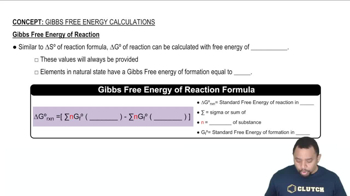
Gibbs Free Energy of Reactions
Equilibrium Constant (Kp)
The equilibrium constant (Kp) quantifies the ratio of the concentrations of products to reactants at equilibrium for a given reaction at a specific temperature. It is influenced by the Gibbs free energy change (ΔG°) of the reaction, where a more negative ΔG° corresponds to a larger Kp, indicating a greater tendency for products to form. Understanding Kp is vital for assessing the extent of the halogenation reactions and their spontaneity.
추천 영상:
가이드 코스
Equilibrium Constant Expressions
관련 실천
교과서 질문
1400
views
교과서 질문
Nitrogen dioxide, a pollutant in the atmosphere, can combine with water to form nitric acid. One of the possible reactions is shown here. Calculate ΔG° and Kp for this reaction at 25 °C and comment on the spontaneity of the reaction. 3 NO2(g) + H2O(l)→ 2 HNO3(aq) + NO(g)
1274
views
교과서 질문
Determine the sign of ΔSsys for each process. b. water freezing
625
views
교과서 질문
Consider this reaction occurring at 298 K: N2O(g) + NO2(g) ⇌ 3 NO(g) b. If a reaction mixture contains only N2O and NO2 at partial pressures of 1.0 atm each, the reaction will be spontaneous until some NO forms in the mixture. What maximum partial pressure of NO builds up before the reaction ceases to be spontaneous?
1806
views